Biology · Endocrine system
The HPA axis, explained gland by gland
It's 8:59 and your exam starts in one minute. Your heart is pounding, and a chain reaction has already started in your brain. That chain is the HPA axis: hypothalamus, pituitary, adrenal. Watch the 3-minute lesson, read the notes, then copy the board into your own notes.
By Boardling, from the Instaboard teamLesson 001 · 3:20 videoUpdated
HPA axis in 30 seconds
- H → P → A: the hypothalamus releases CRH, the anterior pituitary answers with ACTH, and ACTH tells the adrenal cortex to make cortisol.
- The adrenal gland is two glands in one: the cortex makes cortisol (slow, minutes to hours), the medulla releases adrenaline (fast, seconds, nerve-driven).
- Cortisol raises blood sugar (new glucose from the liver), dampens inflammation and parts of the immune system, and helps hold blood pressure up.
- Negative feedback: cortisol tells the hypothalamus and pituitary to slow down, so less CRH and ACTH are released.
- Cortisol peaks soon after waking and is lowest around midnight. With chronic stress it stays high for weeks.
The notes board from the lesson
This is the board built during the video. Copy it and it's yours: add your own cards, rearrange it, draw on it.
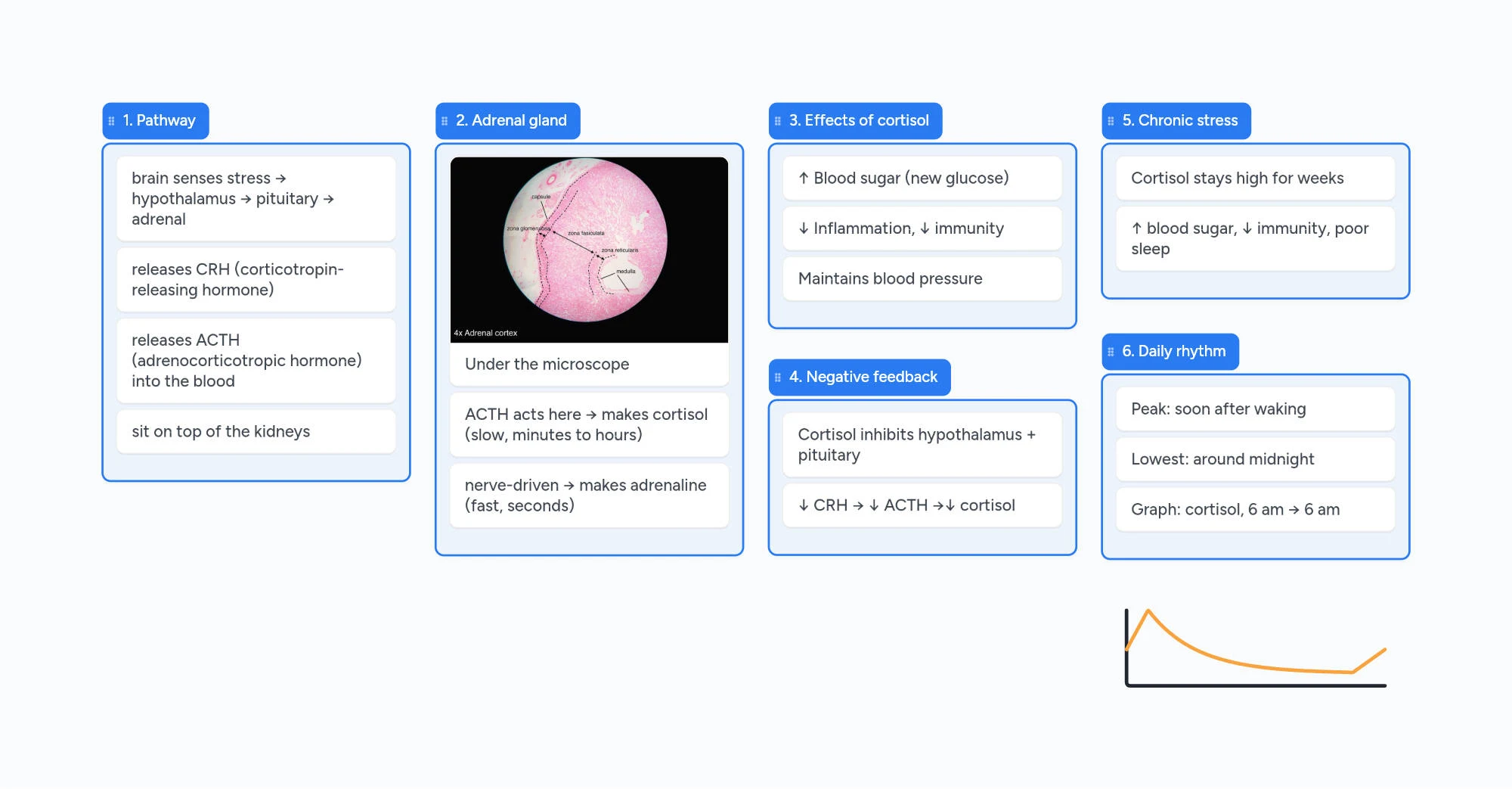
The pathway: CRH, then ACTH, then cortisol
In the video at 0:17
H, P, A stands for hypothalamus, pituitary, adrenal: three glands passing a message down the line.
It starts in the hypothalamus. When your brain senses stress, the hypothalamus releases CRH, corticotropin-releasing hormone. CRH only travels a very short distance, to the anterior pituitary right below it.
The pituitary answers by releasing ACTH, adrenocorticotropic hormone, into the blood. ACTH travels all the way down to the adrenal glands, which sit on top of the kidneys.
Inside the adrenal gland
In the video at 1:02
The adrenal gland is really two glands in one. The outer layer is the cortex. That's where ACTH acts, and the cortex makes cortisol.
The inner core is the medulla. It's wired straight to the nervous system, and it releases adrenaline within seconds.
Two stress responses: fast and slow
In the video at 1:22
So there are actually two stress responses. Adrenaline is the fast one: it's why your heart is already pounding. Cortisol is the slow one: it rises over minutes and keeps you going for hours.
What cortisol does
In the video at 1:36
Cortisol raises blood sugar by getting the liver to make new glucose (gluconeogenesis), so the brain and muscles have fuel. It calms inflammation and parts of the immune system. And it helps hold blood pressure up. Everything shifts toward getting through the next few hours.
Negative feedback: how it switches off
In the video at 2:00
Cortisol travels back to the brain and tells the hypothalamus and the pituitary to slow down. Less CRH, less ACTH, less cortisol. That's negative feedback, and it's what stops the response once the stress is over.
Chronic stress
In the video at 2:18
The trouble starts when the stress never ends. With chronic stress, cortisol stays high for weeks: blood sugar stays up, the immune system stays dampened and sleep suffers. The system that gets you through an exam can wear you down if it never turns off.
Cortisol's daily rhythm
In the video at 2:37
Even without stress, cortisol follows a daily (circadian) rhythm. It peaks soon after you wake up and falls to its lowest around midnight. The board shows it as a hand-drawn curve from 6 am to 6 am.
Practice question
A drug blocks ACTH receptors on the adrenal cortex. What happens to cortisol, and what happens to ACTH?
Show the answer
Cortisol falls, and ACTH rises. The cortex can't respond, so cortisol drops. With less cortisol there's less negative feedback, so the hypothalamus and pituitary release more CRH and ACTH.
Common mix-ups
Cortisol comes from the adrenal medulla.
Cortisol comes from the adrenal cortex. The medulla releases adrenaline.
The hypothalamus releases ACTH.
The hypothalamus releases CRH. The anterior pituitary releases ACTH.
Adrenaline and cortisol are the same response.
Adrenaline is the fast, nerve-driven response (seconds). Cortisol is the slow, hormone-driven one (minutes to hours).
How this lesson was made
Boardling lessons are made by the Instaboard team. The narration is a synthetic (text-to-speech) voice, and the script and these notes were written with AI help, then checked against the sources listed below (last checked October 29, 2026). The notes board is built live in Instaboard during the video. Spotted a mistake? Tell us and we'll fix it.
Put this lesson in your notes
The board opens in your browser in a few seconds. Add your lecture notes, photos of your handwritten pages and your own questions next to it. Sign in for free to keep it.
Questions
What is the HPA axis in simple terms?
It's the chain of three glands that runs your slow stress response. The hypothalamus releases CRH, the anterior pituitary releases ACTH, and the adrenal cortex releases cortisol. Cortisol then switches the chain back down by negative feedback.
What does each letter of HPA stand for?
H is the hypothalamus, P is the pituitary (the anterior pituitary), and A is the adrenal glands (the adrenal cortex).
How does negative feedback work in the HPA axis?
Cortisol travels back to the brain and inhibits the hypothalamus and the anterior pituitary. They release less CRH and ACTH, so the adrenal cortex makes less cortisol.
What is the difference between adrenaline and cortisol?
Adrenaline comes from the adrenal medulla, is triggered by nerves and acts within seconds. Cortisol comes from the adrenal cortex, is triggered by ACTH and acts over minutes to hours.
When is cortisol highest during the day?
Soon after waking up. It falls through the day and is lowest around midnight.
Exam fit
- MCAT 3A: endocrine system
- AP Biology Unit 4
- Anatomy & physiology
- Psychology (stress)