Biology · Muscle and nerve physiology
Twitch, summation and tetanus: how to read a myogram
One nerve signal makes a muscle fibre twitch for a split second, yet you can hold a cup still for a minute. The video builds a myogram live, from a single twitch to a smooth plateau of force; the notes below fix the traces and the two exam traps in your head, and the board is yours to copy.
By Boardling, from the Instaboard teamLesson 006 · 3:44 videoUpdated
Twitch, summation and tetanus in 30 seconds
- A myogram records muscle tension over time. One stimulus gives one twitch: a latent period, contraction, then relaxation.
- Wave summation: a second stimulus before the first twitch has relaxed rides on top of it and peaks higher.
- The reason is calcium: each signal releases Ca2+, and the pump back into the sarcoplasmic reticulum falls behind when signals come fast.
- Unfused (incomplete) tetanus shows ripples on a rising baseline; fused (complete) tetanus is one smooth plateau with no relaxation.
- You hold a cup with the same twitches, arriving faster, from different motor units firing out of step.
The notes board from the lesson
This is the board built during the video. Copy it and it's yours: add your own cards, rearrange it, draw on it.
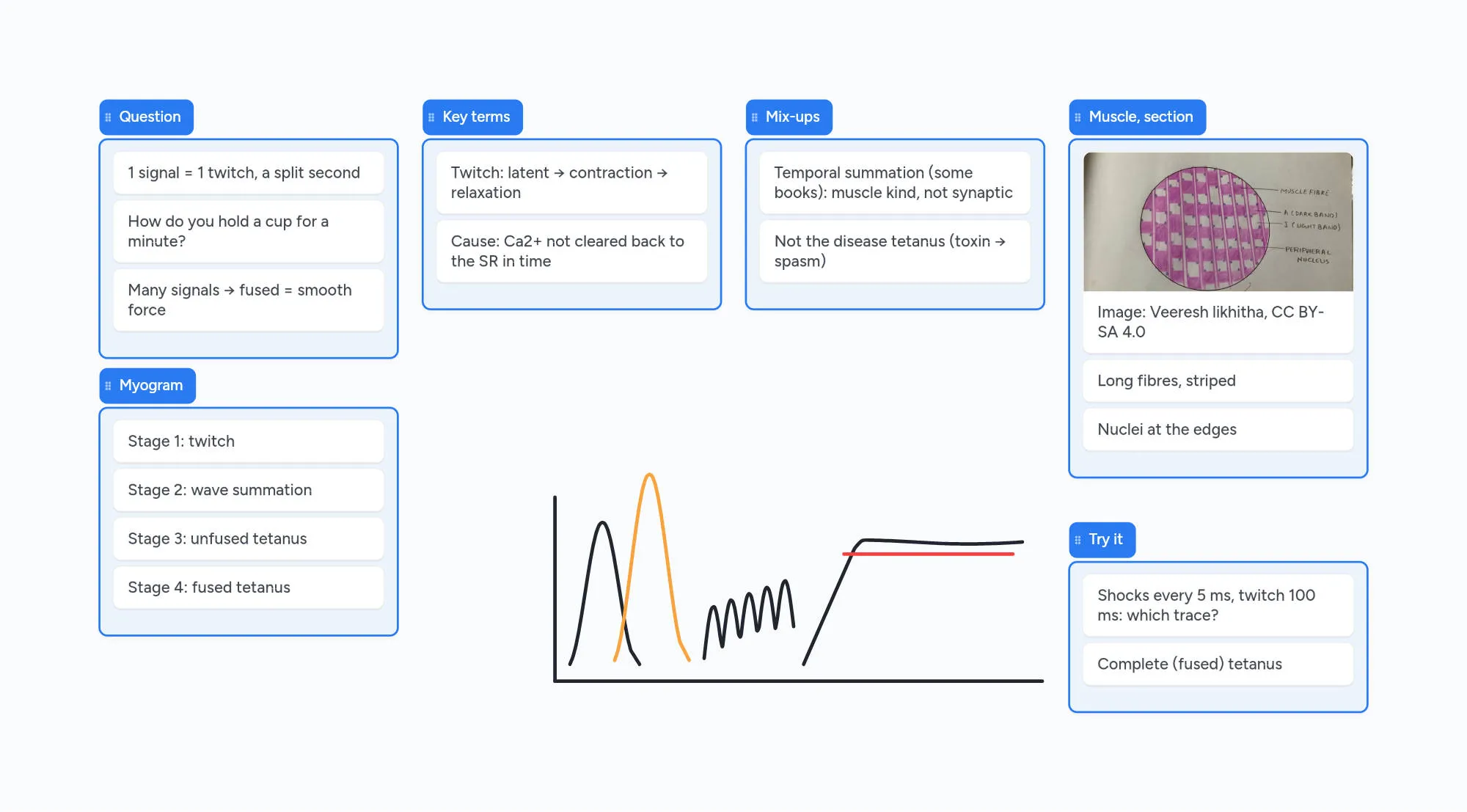
How can a split-second twitch hold a cup for a minute?
In the video at 0:00
A single nerve signal makes a muscle fibre twitch for only a fraction of a second. Yet you can hold a cup perfectly still for a whole minute. Nothing special is going on: it isn't a different kind of muscle, it is the same twitches arriving faster.
The tool for seeing this is the myogram, and once you can read one you can predict the trace for any stimulation rate.
A myogram and one twitch
In the video at 0:24
A myogram is a recording of muscle tension over time. Give the muscle one single shock and the trace shows one twitch, in three parts.
Latent period: a short delay while the signal spreads and calcium is released. Contraction: the fibres shorten and tension rises. Relaxation: the fibres let go and tension falls. Depending on the muscle, one twitch can last from a few milliseconds to about 100 milliseconds.
Wave summation
In the video at 0:55
Now stimulate again before the first twitch has finished relaxing. The second twitch rides on top of the first and peaks higher than it. That stacking is wave summation.
Why it happens: calcium and the SR pump
In the video at 1:07
Every signal releases calcium inside the fibre. Between signals, a pump drags that calcium back into the sarcoplasmic reticulum, and the muscle relaxes as the calcium level falls.
When signals arrive fast, the pump falls behind. Calcium is still sitting in the fibre when the next contraction starts, so the new twitch builds on top of the old one.
Unfused and fused tetanus
In the video at 1:23
Keep raising the frequency and there is less and less relaxation between peaks. The trace shows ripples on a rising baseline: incomplete, or unfused, tetanus.
Go faster still and relaxation disappears completely. Every twitch fuses into one smooth plateau: complete, or fused, tetanus. Because calcium is never cleared between signals, fused tetanus produces far more force than a single twitch ever could.
Skeletal muscle under the microscope
In the video at 1:52
The micrograph on the board shows what is doing all this: long, striped fibres with their nuclei pushed to the edges. Those stripes are the repeating contractile units, and the whole fibre contracts when calcium is available.
Back to the cup
In the video at 2:04
Your motor neurons fire in rapid trains, not once. Each motor unit's twitches summate into sustained tension, and different units fire out of step, so the total pull never drops to zero.
Stillness isn't the absence of twitches. It is twitches summed faster than they can relax.
Two exam traps
In the video at 2:24
Temporal summation. Some textbooks call wave summation in muscle "temporal summation". That is the muscle kind, not the synaptic kind where a neuron adds up inputs over time. Read which one the question means.
Tetanus the disease. The physiology term was named after the disease, whose toxin locks muscles in a sustained spasm. Tetanic contraction in a myogram is a normal response to rapid stimulation, not an infection.
Practice question
A muscle is stimulated once every 200 ms, and each twitch lasts about 100 ms. Do the twitches summate, and what does the myogram show?
Show the answer
No. You see separate, identical twitches with full relaxation between them. Each twitch finishes relaxing before the next stimulus arrives, so calcium is cleared in time and nothing builds on top of the previous peak. Summation needs the next signal to land before relaxation ends.
Common mix-ups
Holding a cup needs a different kind of muscle contraction from a twitch.
It is the same twitches, arriving faster and summed. Different motor units fire out of step, so the total tension stays up.
Tetanus in a myogram means the muscle has been infected.
Tetanic contraction is a normal physiology term for a sustained, fused contraction. It was named after the disease, whose toxin causes a sustained spasm.
Wave summation in muscle is the same thing as summation at a synapse.
Some books call muscle wave summation "temporal summation", but it is the muscle kind: twitches adding up because calcium isn't cleared, not a neuron adding up synaptic inputs.
How this lesson was made
Boardling lessons are made by the Instaboard team. The narration is a synthetic (text-to-speech) voice, and the script and these notes were written with AI help, then checked against the sources listed below (last checked October 31, 2026). The notes board is built live in Instaboard during the video. Spotted a mistake? Tell us and we'll fix it.
Put this lesson in your notes
The board opens in your browser in a few seconds. Add your lecture notes, photos of your handwritten pages and your own questions next to it. Sign in for free to keep it.
Questions
What is a myogram?
A recording of muscle tension over time. One stimulus gives one twitch, and the shape of the trace changes as the stimulation frequency rises.
What are the three parts of a muscle twitch?
The latent period (the signal spreads and calcium is released), contraction (the fibres shorten) and relaxation (the fibres let go).
Why does wave summation happen?
Calcium. Each signal releases calcium, and between signals a pump moves it back into the sarcoplasmic reticulum. When signals come fast, calcium is still present when the next contraction starts, so twitches stack.
What is the difference between unfused and fused tetanus?
In unfused (incomplete) tetanus the trace has ripples because there is a little relaxation between peaks. In fused (complete) tetanus the twitches merge into one smooth plateau with no relaxation, and the force is much higher than a single twitch.
How can you hold something steady if one twitch lasts a split second?
Motor neurons fire in rapid trains, so each motor unit's twitches summate, and different motor units fire out of step. The total tension never drops to zero.
Exam fit
- Anatomy & physiology
- Muscle physiology