Biology · Immune system
Opsonization: how antibodies tag a microbe to be eaten
Opsonization is when a coat of antibody or complement on a microbe lets a phagocyte grab and swallow it. The video draws the IgG tag live and shows real macrophages eating yeast; the notes below keep the terms straight, and the board is yours to copy.
By Boardling, from the Instaboard teamLesson 009 · 3:33 videoUpdated
Opsonization in 30 seconds
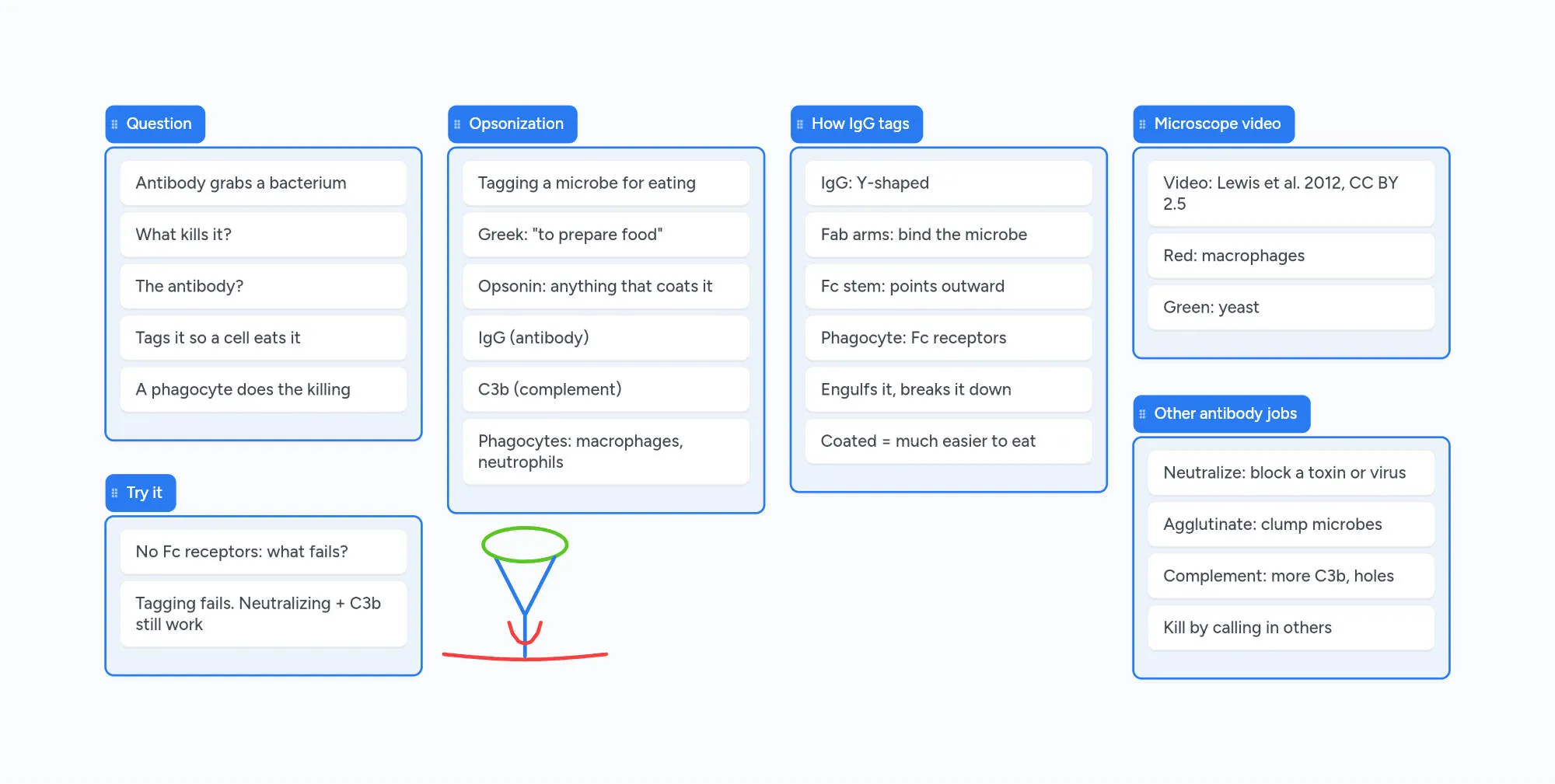
- Opsonization is the coating of a microbe so a phagocyte can grab and eat it more easily; anything that coats it is an opsonin.
- The main opsonins are the antibody IgG and the complement protein C3b. The eating cells are phagocytes, mainly macrophages and neutrophils.
- An IgG is Y-shaped: the two Fab arms bind the microbe, and the Fc stem points outward for the phagocyte's Fc receptors to grab.
- Antibodies also neutralize (Fab only), agglutinate (clump microbes) and activate complement, which adds more C3b tags and can lyse some bacteria.
The notes board from the lesson
This is the board built during the video. Copy it and it's yours: add your own cards, rearrange it, draw on it.
What actually kills the bacterium?
In the video at 0:00
An antibody grabs onto a bacterium. Most people say the antibody then kills it. Usually it does not, at least not on its own. Very often it tags the microbe so another cell will eat it.
Opsonization and opsonins
In the video at 0:29
The tagging has a name: opsonization. The word comes from Greek, roughly meaning to prepare food. Anything that coats a microbe this way is an opsonin.
The two big opsonins are the antibody IgG and a complement protein called C3b. The cells that do the eating are phagocytes, mainly macrophages and neutrophils.
How IgG works as a tag
In the video at 1:02
An IgG antibody is shaped like a Y. The two arms, the Fab ends, bind the microbe. The stem, the Fc end, points outward.
A phagocyte has Fc receptors on its surface that grab the stem. With the microbe held tight, the phagocyte wraps around it and swallows it, and the microbe is broken down inside the cell.
Real footage: macrophages eating yeast
In the video at 1:45
The video shows real footage, sped up from about six hours: red macrophages and green yeast cells, with the green ending up inside the red. This clip shows phagocytosis in general, not opsonization itself.
Phagocytes can catch some microbes without any tag, but a coating makes it much easier.
Other antibody jobs
In the video at 2:10
Tagging is not the only thing antibodies do. They can neutralize, covering a toxin or a virus so it cannot attach to your cells. They can clump microbes together, called agglutination. And they can switch on complement, which adds more C3b tags and can punch holes in some bacteria.
So antibodies do help kill, mostly by calling in other parts of the immune system.
Back to the question
In the video at 2:57
An antibody grabs a bacterium, and a phagocyte usually does the killing. The arms hold the microbe, the stem holds the phagocyte, and the phagocyte eats.
Practice question
A patient makes plenty of normal IgG, but their phagocytes have no Fc receptors. Which antibody job fails, and which still works?
Show the answer
Opsonization by IgG fails, because nothing can grab the Fc stem. Neutralization still works, since it needs only the Fab arms, and C3b tagging still helps a little, because phagocytes have separate receptors for C3b. IgG tagging depends on the Fc end binding an Fc receptor. Neutralizing a toxin needs only the Fab ends, and complement's C3b is recognized by different receptors on the phagocyte.
Common mix-ups
An antibody kills the microbe it binds.
Binding alone usually does not kill. The antibody tags the microbe for a phagocyte, or switches on complement, which can lyse some bacteria.
The Fab end is the part a phagocyte grabs.
The Fab arms bind the microbe. The Fc stem is the handle the phagocyte's Fc receptors grab.
Phagocytes can only eat microbes that have been tagged.
Phagocytes can catch some microbes without a tag, but opsonization makes it much easier.
How this lesson was made
Boardling lessons are made by the Instaboard team. The narration is a synthetic (text-to-speech) voice, and the script and these notes were written with AI help, then checked against the sources listed below (last checked November 3, 2026). The notes board is built live in Instaboard during the video. Spotted a mistake? Tell us and we'll fix it.
Put this lesson in your notes
The board opens in your browser in a few seconds. Add your lecture notes, photos of your handwritten pages and your own questions next to it. Sign in for free to keep it.
Questions
What is opsonization in simple terms?
Coating a microbe with antibody or complement so a phagocyte can grab and eat it more easily. The coating acts like a handle.
What are the main opsonins?
IgG antibodies and the complement protein C3b. IgG is described as an excellent opsonin in OpenStax Microbiology.
What is the difference between the Fab and Fc regions of an antibody?
The Fab arms bind the antigen. The Fc stem points outward and binds Fc receptors on phagocytes and other immune cells.
How is opsonization different from neutralization?
Neutralization needs only the Fab ends: the antibody blocks a toxin or virus from attaching to cells. Opsonization needs the Fc end too, so a phagocyte can grab the coated microbe.
Which cells carry out phagocytosis after opsonization?
Phagocytes, mainly macrophages and neutrophils.
Exam fit
- Immunology
- AP Biology
- Microbiology