Biology · Endocrine system
Posterior pituitary hormones: released there, made somewhere else
The posterior pituitary releases two hormones, and it makes neither of them. The video follows ADH and oxytocin from the hypothalamus down the stalk, on a real pituitary section; the notes below keep the mix-up straight, and the board is yours to copy.
By Boardling, from the Instaboard teamLesson 007 · 2:59 videoUpdated
Posterior pituitary hormones in 30 seconds
- The posterior pituitary (pars nervosa) is nerve tissue. It stores and releases hormones; it does not make them.
- ADH is made mainly in the supraoptic nucleus and oxytocin mainly in the paraventricular nucleus of the hypothalamus.
- Each hormone travels in vesicles down a long axon into the posterior pituitary and waits in the axon endings until the neuron fires.
- ADH: triggered by high blood osmolarity, acts on the collecting ducts, water is kept and urine is concentrated.
- Oxytocin: triggered by cervical stretch and suckling, acts on the uterus and breast: contractions and milk let-down.
The notes board from the lesson
This is the board built during the video. Copy it and it's yours: add your own cards, rearrange it, draw on it.
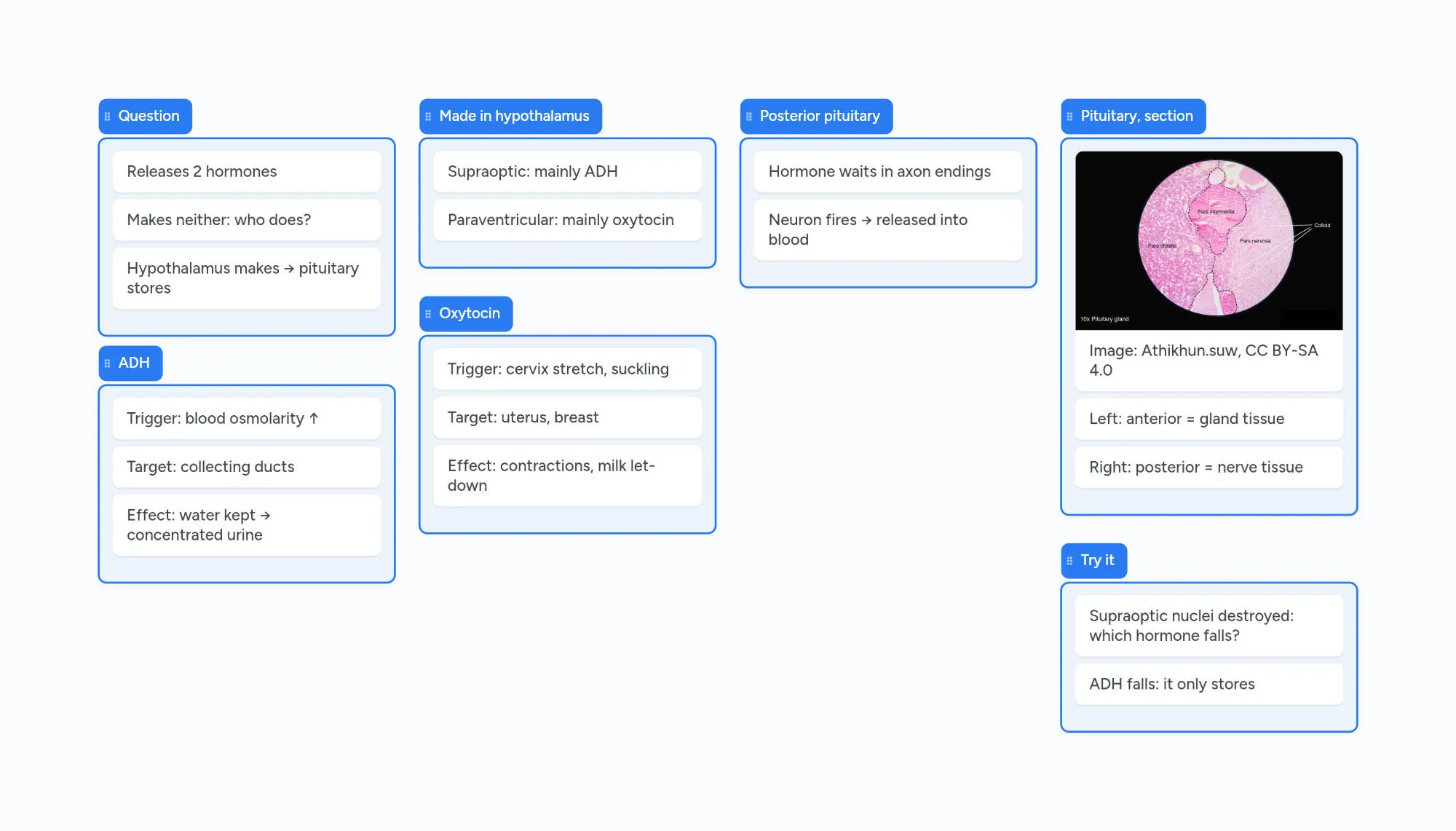
It releases two hormones, and makes neither
In the video at 0:00
Ask where ADH and oxytocin come from and most people say the pituitary. That is the mix-up this lesson clears up: the posterior pituitary releases them, but it does not make them.
Anterior vs posterior: gland tissue vs nerve tissue
In the video at 0:23
The pituitary section on the board shows two very different tissues. On the left is the pars distalis, the anterior pituitary. It is glandular tissue packed with cells that really do make hormones.
On the right is the pars nervosa, the posterior pituitary. It looks different because it isn't gland tissue. It is nerve tissue.
Where the hormones are made
In the video at 0:48
Both hormones are made in the hypothalamus, the part of the brain just above the pituitary. Two clusters of neurons do the work: the supraoptic nucleus makes mainly ADH, and the paraventricular nucleus makes mainly oxytocin.
Down the axons to the posterior pituitary
In the video at 1:06
Each of those neurons has a long axon that runs down the stalk into the posterior pituitary. The hormone is packaged into vesicles, travels down the axon, and waits in the axon endings.
So the posterior pituitary is a storage and release site. When the neuron fires, the hormone is released into nearby capillaries, and the blood carries it away.
ADH, the antidiuretic hormone
In the video at 1:30
When your blood gets too concentrated, say you have been sweating and haven't had any water, the hypothalamus senses it and ADH is released. It acts on the collecting ducts in the kidney, which keep more water. The result is concentrated urine.
Oxytocin
In the video at 1:55
Oxytocin is released when the cervix stretches during labor and when a baby suckles. It acts on the uterus and the breast, and the effects are contractions and milk let-down.
Back to the question
In the video at 2:37
The posterior pituitary releases ADH and oxytocin, but it makes neither. The hypothalamus makes them, the axons carry them down, and the posterior pituitary holds them until the signal to release.
Practice question
A lesion destroys the paraventricular nuclei. Which posterior pituitary hormone falls, and would a stretched cervix still trigger its release?
Show the answer
Oxytocin falls, and a stretched cervix could no longer trigger its release. The paraventricular neurons make mainly oxytocin, and the posterior pituitary only stores what the hypothalamus sends down. With those neurons gone there is nothing to release and no backup source.
Common mix-ups
The posterior pituitary makes ADH and oxytocin.
The hypothalamus makes them. The posterior pituitary is nerve tissue that stores them in axon endings and releases them into the blood.
The whole pituitary is one kind of gland tissue.
The anterior pituitary is glandular tissue that makes its own hormones; the posterior pituitary is neural tissue.
ADH makes your urine more dilute.
ADH acts on the collecting ducts so the kidney keeps more water, which gives concentrated urine. "Antidiuretic" means against making a lot of urine.
How this lesson was made
Boardling lessons are made by the Instaboard team. The narration is a synthetic (text-to-speech) voice, and the script and these notes were written with AI help, then checked against the sources listed below (last checked November 2, 2026). The notes board is built live in Instaboard during the video. Spotted a mistake? Tell us and we'll fix it.
Put this lesson in your notes
The board opens in your browser in a few seconds. Add your lecture notes, photos of your handwritten pages and your own questions next to it. Sign in for free to keep it.
Questions
Where are ADH and oxytocin made?
In the hypothalamus. The supraoptic nucleus makes mainly ADH and the paraventricular nucleus makes mainly oxytocin.
How do ADH and oxytocin get into the blood?
They travel in vesicles down the axons of hypothalamic neurons into the posterior pituitary and wait in the axon endings. When the neuron fires, the hormone is released into nearby capillaries.
Why is the posterior pituitary called neural tissue?
Because it is made of the axon endings of hypothalamic neurons rather than hormone-making gland cells. It stores and releases hormones but does not make them.
What triggers ADH release?
A rise in blood osmolarity, for example after sweating without drinking. The hypothalamus senses it and ADH is released, so the collecting ducts keep more water.
What triggers oxytocin release?
Stretch of the cervix during labor and suckling by a baby. Oxytocin then acts on the uterus (contractions) and the breast (milk let-down).
Exam fit
- Anatomy & physiology
- Endocrine system
- Neuroendocrine
More on the endocrine system
HPA axis
How stress travels from the brain to the adrenal glands: CRH, ACTH, cortisol, negative feedback and the daily rhythm.
Tropic vs non-tropic hormones
Which pituitary hormones act on other glands, the FLAT PEG trick, and how to find the gland that broke.
Steroid vs peptide hormones
Why insulin works in seconds and cortisol takes hours: solubility, receptors, genes vs cAMP, and the amine trap.