Biology · Kidney
Transport maximum: why glucose spills into urine
The kidneys filter about 180 g of glucose a day and almost none reaches the urine, until the carriers run out of seats. The video builds the three-line glucose graph live; the notes below keep the terms straight, and the board is yours to copy.
By Boardling, from the Instaboard teamLesson 008 · 2:51 videoUpdated
Transport maximum in 30 seconds
- Glucose is filtered freely at the blood concentration and normally fully reabsorbed in the proximal tubule by sodium-glucose carriers.
- The carriers have a speed limit and a fixed number: the transport maximum (Tm), about 375 mg/min in men and about 300 mg/min in women.
- Filtered load rises in a straight line with blood glucose; reabsorption follows it, then flattens at Tm; excretion = filtered minus reabsorbed.
- The renal threshold is the blood glucose where glucose first appears in urine, around 180-200 mg/dL (books differ).
- Splay is the rounded corner: some nephrons fill their carriers earlier than others, so glucose appears a little before the filtered load reaches Tm.
The notes board from the lesson
This is the board built during the video. Copy it and it's yours: add your own cards, rearrange it, draw on it.
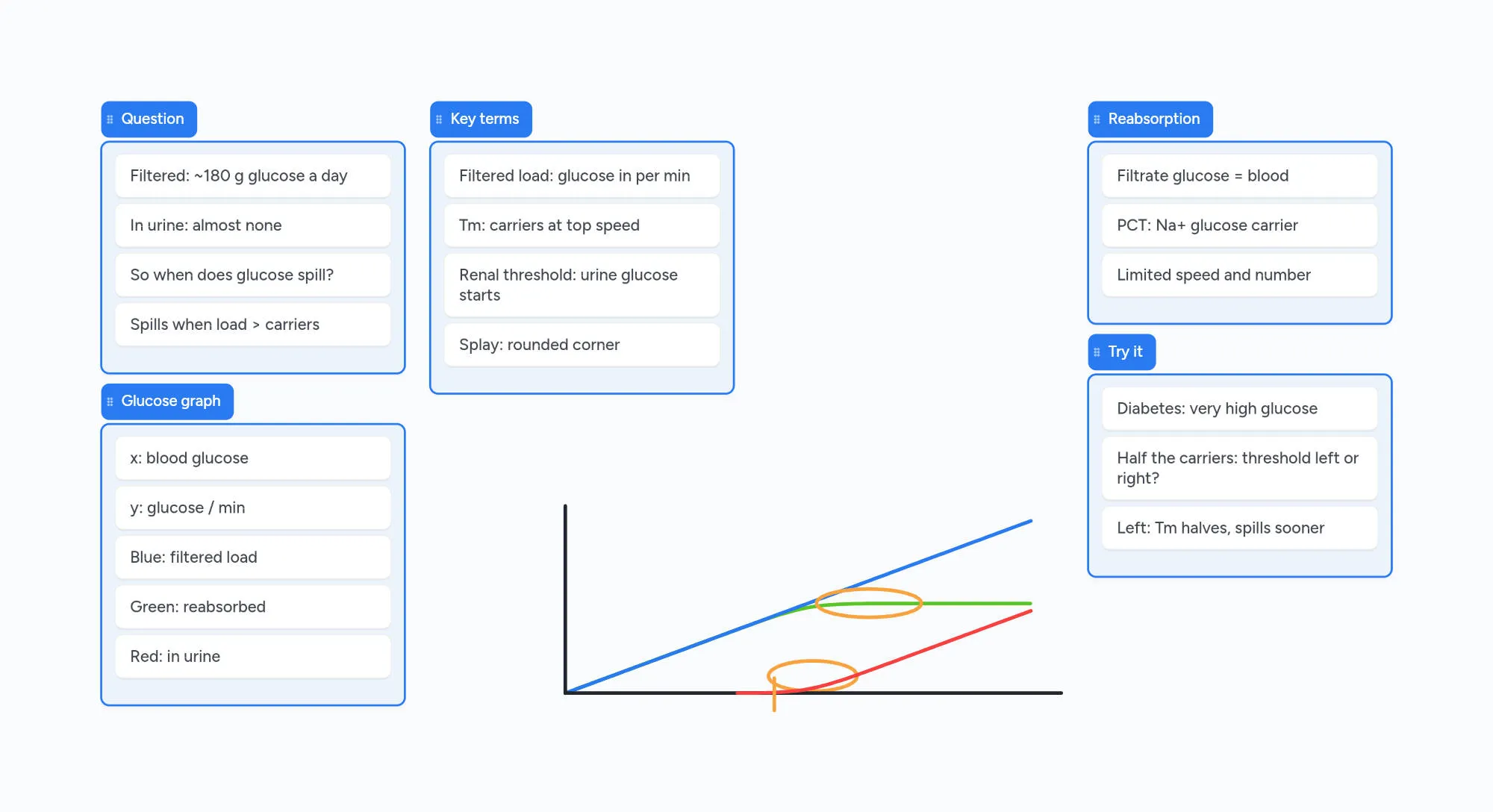
Seats on a bus: when does glucose spill?
In the video at 0:00
Your kidneys filter about 180 g of glucose a day, yet almost none of it reaches your urine. So when does glucose spill? Think of the glucose carriers as seats on a bus: once every seat is taken, the extra glucose rides out in the urine.
Where the glucose goes back
In the video at 0:24
The filtrate carries glucose at the same concentration as the blood. In the proximal tubule, cells pull it back into the blood with a carrier that moves sodium and glucose in together.
Each carrier works at a limited speed and there is a limited number of them. That limit is the whole story.
Setting up the graph
In the video at 0:43
Along the bottom is the glucose level in the blood. Up the side is glucose per minute. Three lines go on this graph, one at a time.
Line 1: filtered load
In the video at 0:56
The filtered load is the glucose entering the tubule each minute. Double the blood glucose and you double the filtered glucose, so it is a straight line.
Line 2: reabsorbed and the transport maximum
In the video at 1:11
At low levels the carriers take back everything, so the reabsorbed line follows the filtered line. Then the carriers fill up and the line flattens into a plateau.
The plateau is the transport maximum, Tm: the most glucose the carriers can take back each minute. Textbook values are about 375 mg/min in men and about 300 mg/min in women.
Line 3: excreted and the renal threshold
In the video at 1:38
Glucose in the urine is filtered minus reabsorbed. It stays at zero while the carriers keep up, then it climbs.
The blood glucose where it first appears is the renal threshold, around 180 to 200 mg/dL, though books differ.
Splay
In the video at 2:00
Glucose starts to appear a little before the filtered load reaches the maximum, because some nephrons fill up before others. That rounded corner on the graph is called splay.
That is why glucose can show up in urine when blood sugar is very high, as in diabetes.
Back to the question
In the video at 2:37
Glucose spills when the filtered load is more than the carriers can take back. Every seat is taken, and the extra rides out.
Practice question
In a healthy adult, blood glucose is 120 mg/dL in one sample and 350 mg/dL in another. For each, is glucose in the urine, and what is the reabsorption rate doing?
Show the answer
At 120 mg/dL there is no glucose in the urine, because reabsorption keeps up with the filtered load. At 350 mg/dL glucose is excreted, and reabsorption sits at its plateau, the transport maximum. 120 mg/dL is below the renal threshold, so the carriers take back all of the filtered glucose. 350 mg/dL is far above it: the carriers are saturated at Tm, and everything beyond that leaves in the urine.
Common mix-ups
Glucose in the urine always means the kidneys are damaged.
In this model the kidney is working normally. Glucose appears because the filtered load rose above what the carriers can take back.
Reabsorbed glucose keeps rising as blood glucose rises.
Reabsorption follows the filtered load only until the carriers saturate. Then it plateaus at the transport maximum.
Glucose appears in urine exactly when the filtered load reaches Tm.
It appears a little earlier. Nephrons differ, so some saturate before the average does, and the graph shows a rounded corner called splay.
How this lesson was made
Boardling lessons are made by the Instaboard team. The narration is a synthetic (text-to-speech) voice, and the script and these notes were written with AI help, then checked against the sources listed below (last checked November 3, 2026). The notes board is built live in Instaboard during the video. Spotted a mistake? Tell us and we'll fix it.
Put this lesson in your notes
The board opens in your browser in a few seconds. Add your lecture notes, photos of your handwritten pages and your own questions next to it. Sign in for free to keep it.
Questions
What is the transport maximum for glucose?
The greatest rate at which the proximal tubule carriers can reabsorb glucose, about 375 mg/min in men and about 300 mg/min in women in common textbook values.
What is the renal threshold for glucose?
The blood glucose level at which glucose first appears in the urine, around 180 to 200 mg/dL. Textbooks quote slightly different numbers.
Why is the filtered glucose line straight?
Glucose is filtered freely, so the amount entering the tubule each minute is proportional to the blood concentration. Double the blood glucose, double the filtered load.
What is splay on the glucose titration curve?
The rounded corner where the excretion line leaves zero. Nephrons have different carrier capacities, so some begin spilling glucose before the average reaches Tm.
Which carrier takes glucose back into the blood in the proximal tubule?
A sodium-glucose cotransporter on the tubule cells, which moves sodium and glucose in together; glucose then leaves the cell into the blood.
Exam fit
- Anatomy & physiology
- Renal physiology
- Kidney