Biology · Muscle and nerve physiology
Motor unit recruitment: why small units fire first
You can pick up a pencil and then a suitcase with the same muscle group. The video builds the answer live: what a motor unit is, why small units are recruited first, and the two ways a muscle grades its force; the notes below keep the terms straight, and the board is yours to copy.
By Boardling, from the Instaboard teamLesson 010 · 2:57 videoUpdated
Motor unit recruitment in 30 seconds
- A motor unit is one motor neuron plus all the muscle fibers it supplies. When the neuron fires, every fiber in its unit contracts together.
- Small units have few fibers and a small, low-threshold neuron. Large units have many fibers and a large, high-threshold neuron.
- The size principle: units are recruited from small to large, because small neurons need less input to reach threshold. Large units join only when much more force is needed.
- A muscle grades its force two ways: each unit can fire faster so its twitches summate, or the nervous system can add more units. Adding units is recruitment.
The notes board from the lesson
This is the board built during the video. Copy it and it's yours: add your own cards, rearrange it, draw on it.
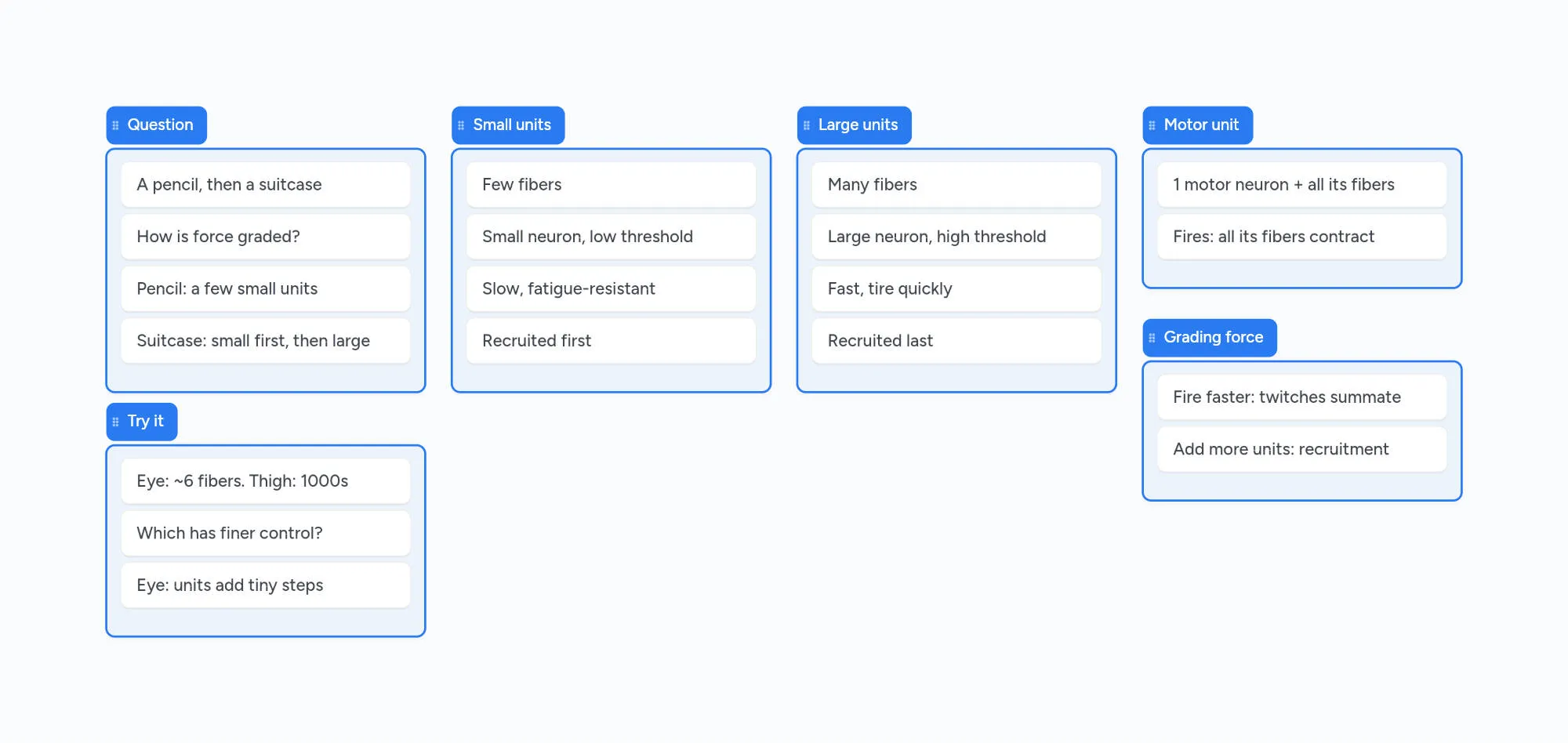
Pencil, then suitcase: how is force graded?
In the video at 0:00
You pick up a pencil, and then a suitcase. It is the same muscle group, yet the force is very different. The nervous system has to dial the force up and down, and it does it with a simple rule about which parts of the muscle switch on first.
What a motor unit is
In the video at 0:19
Every skeletal muscle fiber is supplied by exactly one motor neuron. The group of fibers supplied by a single motor neuron is a motor unit.
When that neuron fires, every fiber in its unit contracts together. The unit is the smallest piece of a muscle you can switch on by itself.
Small units vs large units
In the video at 0:33
Units come in different sizes. A small unit has few fibers and a small neuron with a low threshold. Its fibers tend to be slow and resist fatigue.
A large unit has many fibers and a large neuron with a high threshold. Its fibers tend to be fast and tire quickly.
The eye muscles are the textbook small units: roughly every six fibers share a neuron, which allows very fine control. Thigh and back muscles are the textbook large units, where one neuron supplies thousands of fibers.
The size principle
In the video at 1:01
Motor units are recruited from small to large. This is called the size principle. The small neurons are more excitable, so they reach threshold first. The large neurons join only when you need much more force.
For a pencil, only a few small units fire, and each one adds a tiny step of force. For a suitcase, the small units are already on and large units are added on top. In some muscles the strongest units give about fifty times the force of the smallest.
The name comes from the physiologist Elwood Henneman, who reported in 1957 that motor neurons are recruited in order of size, from small to large. The slow, fatigue-resistant and fast, tiring fibers of small and large units are described in OpenStax 10.5 on muscle fiber types.
Two ways to grade force
In the video at 1:43
A muscle has two ways to grade its force. One: each unit can fire faster, so its twitches summate, as in the lesson on twitch, summation and tetanus. Two: the nervous system can add more units. That second one is recruitment.
Back to the question
In the video at 2:35
For a pencil, a few small units. For a suitcase, small units first, then more and larger ones. The same muscle group covers both jobs because the nervous system chooses how many units, and which sizes, to switch on.
Practice question
Eye muscles have about six fibers per motor unit, while thigh muscles have thousands. Which gives finer control, and why?
Show the answer
The eye muscles. Each unit you add is only a small step in force, so the force can be adjusted in tiny steps. In a thigh muscle each added unit is a big jump. With few fibers per unit, recruiting one more unit changes the force very little. With thousands of fibers per unit, one more unit changes it a lot, which suits powerful, gross movements rather than fine ones.
Common mix-ups
A muscle makes more force by making each fiber contract harder.
When a motor neuron fires, every fiber in its unit contracts together. The muscle grades force by firing units faster and by recruiting more units.
Large motor units fire first because they are the strongest.
Small units fire first. Their small neurons have a low threshold. Large units, with high-threshold neurons, join only when much more force is needed.
All the motor units in a muscle are active at the same time.
Motor units are generally not all active together. Some rest while others work, which allows longer contractions.
How this lesson was made
Boardling lessons are made by the Instaboard team. The narration is a synthetic (text-to-speech) voice, and the script and these notes were written with AI help, then checked against the sources listed below (last checked November 5, 2026). The notes board is built live in Instaboard during the video. Spotted a mistake? Tell us and we'll fix it.
Put this lesson in your notes
The board opens in your browser in a few seconds. Add your lecture notes, photos of your handwritten pages and your own questions next to it. Sign in for free to keep it.
Questions
What is a motor unit?
One motor neuron and all the muscle fibers it supplies. When the neuron fires, all of those fibers contract together.
What is the size principle?
Motor units are recruited in order from small to large. Small neurons are more excitable and reach threshold first, so small units fire first and large units join as more force is needed.
What is motor unit recruitment?
Increasing the force of a contraction by activating more motor units. As more units are recruited, the contraction grows progressively stronger.
How does a muscle grade its force?
Two ways: the rate at which each motor neuron fires, which makes twitches summate, and the number of motor units that are active.
Why do eye muscles have such fine control?
Their motor units are small, about six fibers per neuron, so each unit that is recruited adds only a small step of force.
Exam fit
- A&P
- AP Biology
- MCAT biology
Sources
- OpenStax Anatomy & Physiology 2e, 10.4 Nervous System Control of Muscle Tension: motor units and recruitment (checked November 5, 2026)
- OpenStax Anatomy & Physiology 2e, 10.5 Types of Muscle Fibers: slow and fast fibers (checked November 5, 2026)
- Henneman E. (1957), Relation between size of neurons and their susceptibility to discharge, Science 126:1345–1347, as cited in Bawa, Jones and Stein (2014), Assessment of size ordered recruitment, Frontiers in Human Neuroscience 8:532: the size principle, recruitment always from small to large (read November 5, 2026)