Biology · Muscle and nerve physiology
Action potential for the MCAT: every step on the graph
Every nerve signal is the same size, so how can a nerve tell a light touch from a hard hit? The video follows one action potential across the graph, step by step, while the notes build live on a board. The notes below add the exam terms the video leaves out, and the board is yours to copy.
By Boardling, from the Instaboard teamLesson 013 · 2:21 videoUpdated
Action potential in 30 seconds
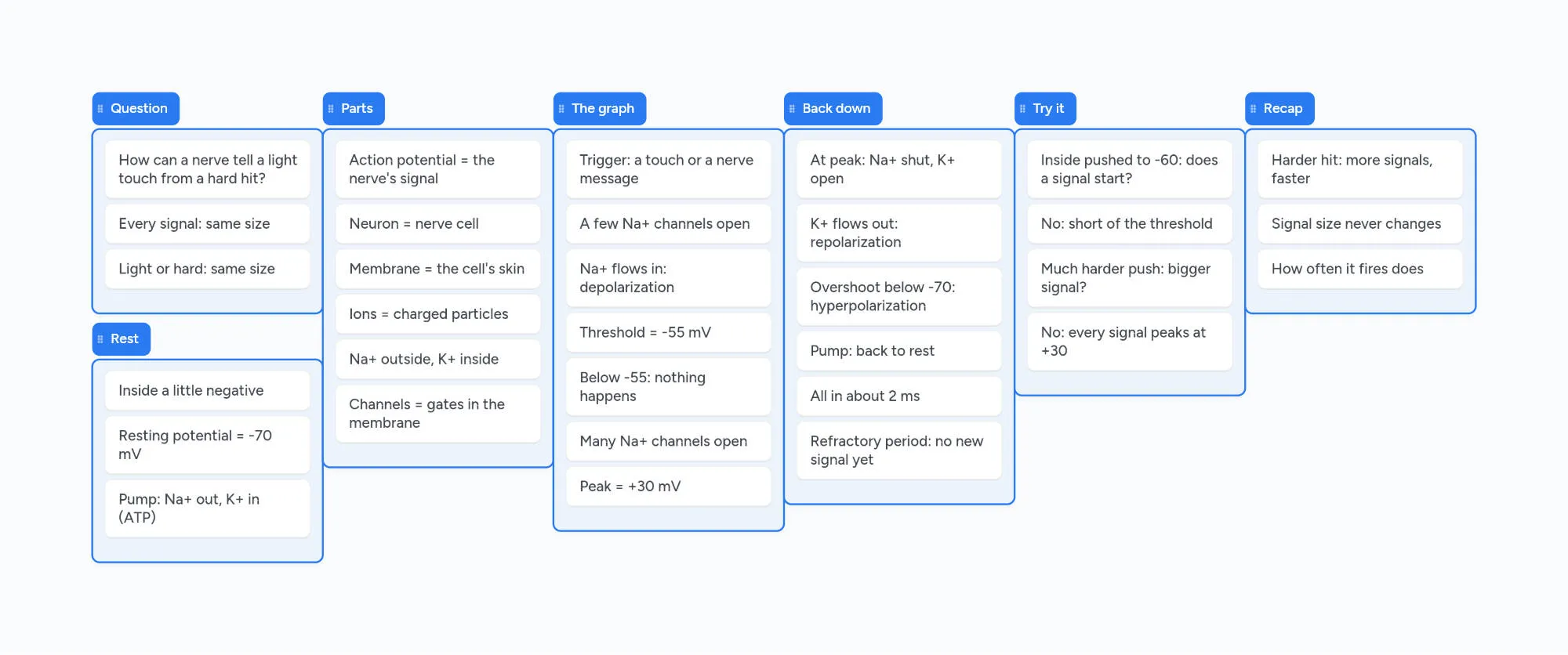
- At rest the inside of a neuron is about -70 mV compared with the outside: the resting potential. The Na+/K+ pump uses ATP to keep sodium outside and potassium inside.
- A stimulus lets sodium in and the inside becomes less negative (depolarization). If it reaches the threshold of about -55 mV, voltage-gated Na+ channels open and the inside shoots up to a peak of about +30 mV.
- At the peak the Na+ channels shut and K+ channels open; potassium flows out (repolarization). The K+ channels close slowly, so the voltage dips below -70 mV (hyperpolarization) before settling back to rest.
- The whole signal takes about 2 ms. During the refractory period a new one can't start. Every action potential peaks at the same voltage (all-or-none), so a stronger stimulus makes more signals, faster, never a bigger one.
The notes board from the lesson
This is the board built during the video. Copy it and it's yours: add your own cards, rearrange it, draw on it.
Every signal is the same size
In the video at 0:00
A light touch and a hard hit both send action potentials of exactly the same size along a nerve. So the size of the signal can't be what carries the difference. The answer comes from following one action potential across the graph of voltage against time.
Neuron, membrane, ions and channels
In the video at 0:13
An action potential is the electrical signal of a neuron (a nerve cell). The neuron is wrapped in a membrane, and charged particles called ions sit on both sides of it: the concentration of Na+ (sodium) is about 10 times higher outside the cell, and K+ (potassium) is higher inside.
Ions cross only through ion channels, proteins that act as gates. Exams name four kinds by what opens them: voltage-gated channels open when the voltage across the membrane changes (these drive the action potential), ligand-gated channels open when a signaling molecule such as a neurotransmitter binds, mechanically gated channels open when the membrane is stretched or pressed (many touch receptors), and leakage channels open and close at random.
Resting potential and the pump
In the video at 0:34
At rest the inside of the membrane is slightly negative compared with the outside, about -70 mV. That is the resting membrane potential; the exact value varies between cells, but -70 mV is the number most courses use.
The Na+/K+ pump keeps the ions where they are: it uses energy from ATP to move sodium out and potassium in, against their concentration gradients, which is why it is also called an ATPase.
Depolarization and threshold
In the video at 0:49
A stimulus, such as touch on the skin or a neurotransmitter from another neuron, opens a few channels and lets Na+ in. Sodium is positive, so the inside becomes less negative: depolarization.
If the inside reaches about -55 mV, the threshold, voltage-gated Na+ channels open in large numbers, Na+ rushes in and the voltage climbs to a peak of about +30 mV. Below threshold nothing else happens and no action potential starts.
Exam detail: the voltage-gated Na+ channel has two gates. The activation gate opens at -55 mV; the inactivation gate closes a fraction of a millisecond later, which is what stops the sodium flow at the peak.
Repolarization, hyperpolarization and the refractory period
In the video at 1:15
At the peak the Na+ channels shut and voltage-gated K+ channels open. Potassium is positive and flows out, so the inside drops back toward -70 mV: repolarization.
The K+ channels close slowly, so a little too much potassium leaves and the voltage dips below -70 mV: hyperpolarization. Then the channels close and the pump and leakage channels bring the cell back to rest.
The whole action potential takes about 2 milliseconds. While it is in progress another one can't start: the refractory period. In the absolute refractory period no stimulus can start a new signal, because the Na+ inactivation gates are still closed. In the relative refractory period a new signal can start, but only with a stronger stimulus than usual.
Back to the question
In the video at 2:00
Action potentials are all-or-none: once the threshold is reached, every one peaks at the same voltage. A harder hit can't make a bigger signal, so it makes more signals, faster. The nerve codes strength by how often it fires, not by how big each signal is.
How the signal then travels along the axon is called propagation: along an unmyelinated axon it moves continuously, and along a myelinated axon it jumps from one node of Ranvier to the next (saltatory conduction), which is faster. What happens when the signal reaches a muscle is covered in motor unit recruitment and twitch, summation and tetanus.
Practice question
A stimulus moves a resting neuron's inside from -70 mV to -50 mV. Does an action potential start, and how high does it peak?
Show the answer
Yes. -50 mV is past the -55 mV threshold, so an action potential starts, and it peaks at about +30 mV like every other one. Reaching threshold opens the voltage-gated Na+ channels in large numbers. Past that point the size of the stimulus no longer matters: the signal is all-or-none and always peaks at the same voltage.
Common mix-ups
A stronger stimulus makes a bigger action potential.
Every action potential peaks at the same voltage. A stronger stimulus makes more action potentials, more quickly.
Repolarization happens because sodium is pumped back out of the cell.
Repolarization happens because voltage-gated K+ channels open and potassium flows out. The Na+/K+ pump restores the ion balance afterwards.
During the refractory period the neuron can never fire again until it is back at rest.
Only the absolute refractory period blocks a new signal completely. In the relative refractory period a stronger-than-usual stimulus can start one.
How this lesson was made
Boardling lessons are made by the Instaboard team. The narration is a synthetic (text-to-speech) voice, and the script and these notes were written with AI help, then checked against the sources listed below (last checked November 11, 2026). The notes board is built live in Instaboard during the video. Spotted a mistake? Tell us and we'll fix it.
Put this lesson in your notes
The board opens in your browser in a few seconds. Add your lecture notes, photos of your handwritten pages and your own questions next to it. Sign in for free to keep it.
Questions
What are the steps of an action potential?
Resting potential (about -70 mV), depolarization to the threshold (about -55 mV), a fast rise to the peak (about +30 mV), repolarization as K+ flows out, hyperpolarization below -70 mV, and a return to rest.
What is the threshold potential?
The voltage, about -55 mV, at which voltage-gated Na+ channels open in large numbers. A depolarization that stops short of it does not start an action potential.
Why does hyperpolarization happen?
Voltage-gated K+ channels close slowly, so potassium keeps leaving for a short time after the voltage has reached -70 mV, and the inside becomes more negative than at rest.
What does all-or-none mean for an action potential?
Either the membrane reaches threshold and a full action potential fires, or it doesn't and nothing else happens. There is no half-sized action potential.
Is the peak of an action potential +30 mV or +40 mV?
Textbooks round it differently: OpenStax Anatomy & Physiology uses +30 mV, OpenStax Biology about +40 mV. What matters on an exam is that every action potential in a given neuron peaks at the same value.
Exam fit
- MCAT biology
- A&P
- AP Biology
Sources
- OpenStax Anatomy & Physiology 2e, 12.4 The Action Potential: resting potential, threshold, Na+ and K+ channels, peak, hyperpolarization, refractory periods, gated channels, propagation (checked November 11, 2026)
- OpenStax Biology 2e, 35.2 How Neurons Communicate: threshold, all-or-none, refractory period, saltatory conduction (checked November 11, 2026)