Biology · Muscle and nerve physiology
The Frank-Starling law: more filling, stronger beat
Let more blood fill your heart and the very next beat is stronger, just from the filling. The video follows why, from the ventricle down to the sarcomere, while the notes build live on a board. The notes below add the exam terms the video leaves out, and the board is yours to copy.
By Boardling, from the Instaboard teamLesson 014 · 2:19 videoUpdated
Frank-Starling law in 30 seconds
- Stroke volume is the blood one ventricle pushes out in one beat: what was in it before the squeeze (EDV, end-diastolic volume) minus what is left after (ESV, end-systolic volume).
- Preload is the stretch on the ventricles just before they contract. More filling means a bigger EDV, so more preload.
- More stretch makes the sarcomeres longer. Up to their best length, more myosin heads can bind to the actin of the thin filaments, so the squeeze is stronger.
- Frank-Starling law: within normal limits, the force of the heart's contraction is directly proportional to the starting length of the muscle fibers. More filling → stronger beat → bigger stroke volume.
The notes board from the lesson
This is the board built during the video. Copy it and it's yours: add your own cards, rearrange it, draw on it.
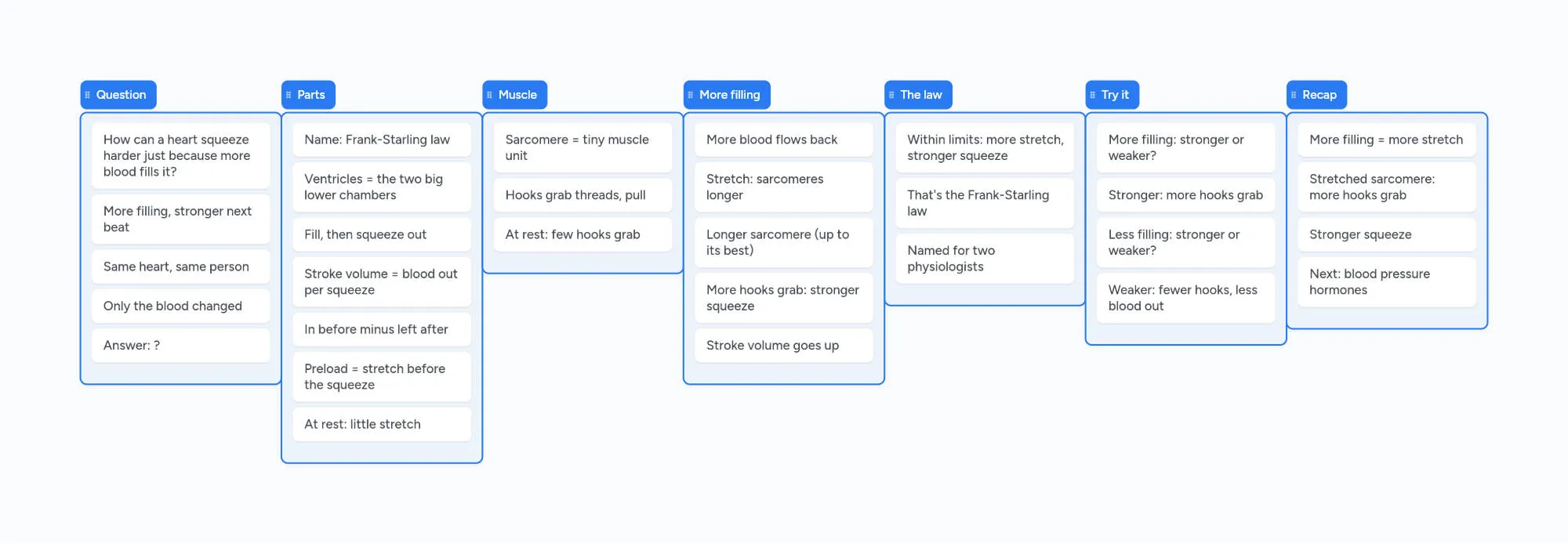
Same heart, stronger beat
In the video at 0:00
When more blood fills the heart, the very next beat is stronger. Nothing else has to change: no signal from a nerve or a hormone is needed. The heart muscle itself responds to how far it is stretched, and that is the Frank-Starling law.
Ventricles and stroke volume
In the video at 0:21
The two big lower chambers of the heart, the ventricles, fill with blood and then squeeze it out. The amount pushed out by one squeeze is the stroke volume (SV).
The exam words for the two amounts are end-diastolic volume (EDV), the blood in the ventricle at the end of filling, and end-systolic volume (ESV), the blood left after the squeeze. So SV = EDV − ESV. A typical resting stroke volume is about 70 mL (normal range 55–100 mL).
Preload
In the video at 0:36
Preload is the stretch on the ventricles just before they contract. It is another way of expressing EDV: the more blood fills the ventricle, the greater the preload.
What raises it: more venous return (blood coming back to the heart through the veins) and a longer filling time. Most filling happens while the whole heart is relaxed, and the atrial kick, the contraction of the atria, adds the last 20–30 percent. A very fast heart rate shortens filling time, so preload can fall.
Why stretch makes a stronger squeeze
In the video at 0:45
Heart muscle is built from repeating units called sarcomeres. Inside each one, myosin heads (the hooks in the video) bind to the actin of the thin filaments, forming cross-bridges, and pull.
At rest there is little stretch and the sarcomeres stay short, so only some myosin heads can bind. As filling stretches the muscle, the sarcomeres get longer, and as they reach their best (optimal) length, more myosin heads can bind at once, so the contraction is stronger and the stroke volume rises.
Stretched past the optimal length, the force would fall again. In a healthy heart this overstretch is not a concern, because the heart's position in the chest limits how far it can stretch.
The Frank-Starling law
In the video at 1:20
Within physiological limits, the force of heart contraction is directly proportional to the initial length of the muscle fiber. More preload, a stronger squeeze, a bigger stroke volume. Less filling works the other way: less stretch, fewer cross-bridges, a weaker squeeze.
It is named for Otto Frank (1865–1944), a German physiologist, and Ernest Starling (1866–1927), an English physiologist, who worked largely independently and reached similar conclusions.
Contractility and afterload: the other two factors
Stroke volume depends on three factors. Preload is the one this lesson follows. Contractility is the force of the contraction itself at a given stretch: a stronger contraction gives a bigger SV and a smaller ESV. Things that raise contractility are called positive inotropes (sympathetic stimulation, epinephrine and norepinephrine, thyroid hormone); things that lower it are negative inotropes (parasympathetic stimulation). Textbooks also list some heart drugs in each group; this page gives no medical advice.
Afterload is the tension the ventricles must build to push blood out against the resistance in the blood vessels. Higher resistance, or a stiff narrowed valve, raises afterload.
Back to the question
In the video at 1:55
A heart squeezes harder when more blood fills it because the filling stretches the muscle, and a stretched sarcomere, up to its best length, lets more myosin heads grab at once. More filling, more stretch, more cross-bridges, a stronger squeeze.
Practice question
Venous return drops, so less blood fills the ventricle before each beat. What happens to preload, the force of contraction and stroke volume?
Show the answer
All three go down. Less filling means a smaller EDV, so less preload. The sarcomeres are stretched less, so fewer myosin heads can bind and the squeeze is weaker. A weaker squeeze pushes out less blood, so stroke volume falls.
Common mix-ups
Preload is the resistance the heart pumps against.
Preload is the stretch before the squeeze (EDV). The resistance the ventricles pump against is afterload.
The heart beats harder with more filling because a nerve or hormone tells it to.
The Frank-Starling effect comes from the muscle itself: more stretch lets more myosin heads bind. Nerves and hormones change contractility, which is a separate factor.
The more the heart is stretched, the stronger it squeezes, without limit.
Only within normal limits. Past the sarcomeres' best length the force would fall, though in a healthy heart that overstretch doesn't happen.
How this lesson was made
Boardling lessons are made by the Instaboard team. The narration is a synthetic (text-to-speech) voice, and the script and these notes were written with AI help, then checked against the sources listed below (last checked November 11, 2026). The notes board is built live in Instaboard during the video. Spotted a mistake? Tell us and we'll fix it.
Put this lesson in your notes
The board opens in your browser in a few seconds. Add your lecture notes, photos of your handwritten pages and your own questions next to it. Sign in for free to keep it.
Questions
What is the Frank-Starling law in simple terms?
The more blood fills the heart before a beat, the more the muscle is stretched and the harder it squeezes, so more blood goes out. It holds within normal limits.
How do you calculate stroke volume?
Stroke volume = end-diastolic volume − end-systolic volume (SV = EDV − ESV): the blood in the ventricle before the squeeze minus what is left after.
Is preload the same as end-diastolic volume?
Preload is the stretch on the ventricles before contraction, and textbooks treat it as another way of expressing EDV: the bigger the EDV, the greater the preload.
What is the difference between preload and contractility?
Preload is how far the muscle is stretched before it squeezes. Contractility is how strongly it squeezes at a given stretch, changed by inotropes such as sympathetic stimulation.
Exam fit
- A&P
- MCAT biology
- Nursing
Sources
- OpenStax Anatomy & Physiology 2e, 19.4 Cardiac Physiology: stroke volume, EDV and ESV, preload, the Frank-Starling mechanism, atrial kick, contractility and inotropes, afterload (checked November 11, 2026)
- OpenStax Anatomy & Physiology 2e, 10.3 Muscle Fiber Contraction and Relaxation: sarcomeres, myosin heads, actin, cross-bridges (checked November 11, 2026)
More on the muscle and nerve physiology
Twitch, summation and tetanus
How to read a myogram: one twitch, wave summation, unfused and fused tetanus, and why calcium makes twitches add up.
Motor unit recruitment
How a muscle grades its force: motor units, small versus large units, the size principle, and the two ways to turn force up.
Sliding filament theory
How a muscle gets shorter when its threads never do: actin and myosin, cross-bridges, the power stroke, ATP and the calcium switch, in plain words.
Action potential
Every step of the action potential graph for the MCAT: resting potential, threshold, depolarization, the +30 mV peak, repolarization, hyperpolarization and the refractory period.