Biology · Digestion
Digestive enzymes: starch, protein and fat, step by step
Your pancreas makes enzymes that can digest protein, yet it is full of protein itself. The video follows a meal from mouth to small intestine to show how that works, while the notes build live on a board. The notes below add the exam terms the video leaves out, and the board is yours to copy.
By Boardling, from the Instaboard teamLesson 019 · 2:40 videoUpdated
Digestive enzymes in 30 seconds
- Each digestive enzyme cuts one kind of big molecule. Starch digestion starts in the mouth (salivary amylase), protein digestion starts in the stomach (HCl and pepsin), and virtually all fat digestion happens in the small intestine.
- In the small intestine, bile from the liver breaks fat into small droplets (emulsification; bile is not an enzyme), and pancreatic juice brings bicarbonate to buffer the stomach acid plus pancreatic amylase, lipase and the protein enzymes.
- The pancreas makes its protein enzymes in inactive forms, such as trypsinogen. Enteropeptidase on the intestine wall turns trypsinogen into trypsin, and trypsin then activates the others. Amylase, lipase and nucleases are released active, because they don't attack the pancreas.
- Brush border enzymes on the intestine wall (lactase, sucrase, maltase, peptidases) finish the job, leaving molecules small enough to be absorbed.
The notes board from the lesson
This is the board built during the video. Copy it and it's yours: add your own cards, rearrange it, draw on it.
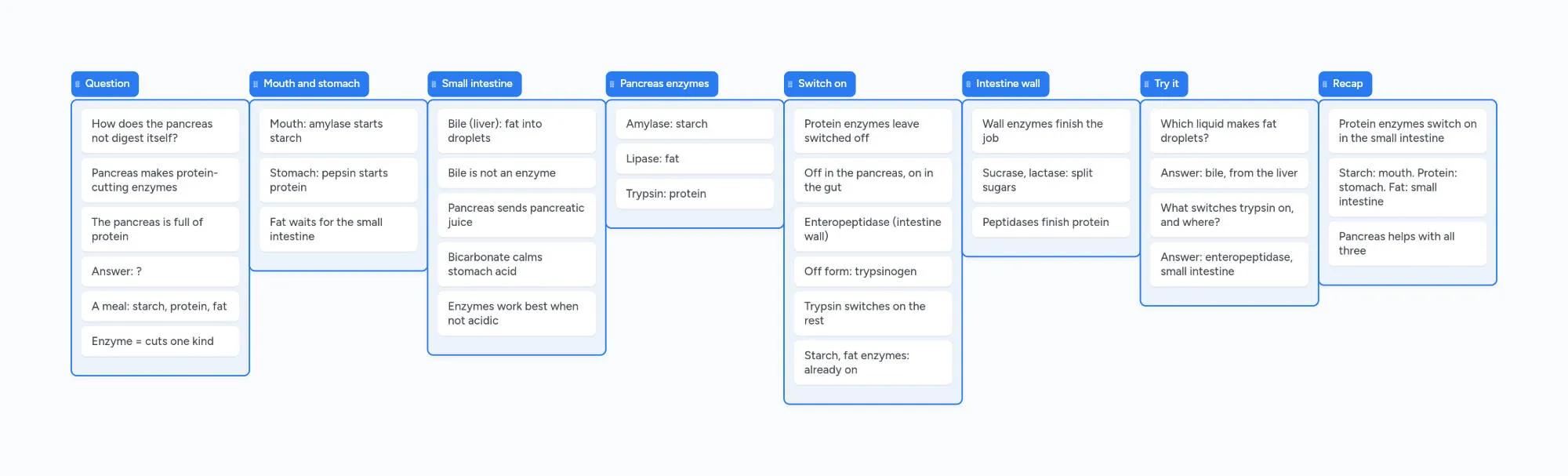
Why doesn't the pancreas digest itself?
In the video at 0:00
The pancreas makes enzymes that cut protein, and the pancreas itself is full of protein. The book puts the danger plainly: if the protein-digesting enzymes were produced in an active form, they would digest the pancreas. The answer is in where each enzyme is switched on.
A meal: starch, protein, fat
In the video at 0:10
Chemical digestion breaks food into its building blocks: starch into sugars, protein into amino acids, fat (triglycerides) into fatty acids and monoglycerides, and nucleic acids into nucleotides. Each enzyme acts on one kind of molecule, its substrate.
Mouth and stomach
In the video at 0:23
Salivary amylase starts starch digestion in the mouth. Protein digestion starts in the stomach, where HCl and pepsin break proteins into smaller polypeptides. Pepsin is itself made switched off: the stomach's chief cells secrete pepsinogen, its inactive form, and HCl is needed to turn it into pepsin.
Fat digestion barely starts before the small intestine. The book lists lingual lipase (from glands in the tongue) and gastric lipase (from the stomach's chief cells), but because the pancreas is the only consequential source of lipase, virtually all fat digestion occurs in the small intestine.
Small intestine: bile
In the video at 0:39
Fat doesn't mix with the watery contents of the gut, so big fat globules are first broken into small ones. This is emulsification, and bile does it. The liver secretes about a liter of bile a day; the gallbladder stores and concentrates it between meals. Bile salts and phospholipids have a water-loving side and a fat-loving side, which lets them coat small fat droplets. Bile contains no digestive enzyme; it gives lipase more surface to work on.
Pancreatic juice
In the video at 0:52
The pancreas delivers pancreatic juice to the duodenum (the first part of the small intestine). It does two jobs. Its bicarbonate buffers the acidic chyme from the stomach, stops pepsin and gives the pH-sensitive enzymes in the small intestine the conditions they work best in. Its enzymes do most of the digesting: pancreatic amylase does the heavy lifting for starch, pancreatic lipase splits each triglyceride into two free fatty acids and a monoglyceride, nucleases digest DNA and RNA, and trypsin, chymotrypsin, carboxypeptidase and elastase cut proteins.
Two hormones control the juice. Acidic chyme entering the duodenum releases secretin, which makes the duct cells release bicarbonate-rich juice. Protein and fat in the duodenum release CCK (cholecystokinin), which makes the acinar cells release enzyme-rich juice; CCK also increases bile production.
The puzzle: enzymes made switched off
In the video at 1:14
The pancreas makes its protein-digesting enzymes in inactive forms, and they are activated only in the duodenum. On the wall of the small intestine, the brush border enzyme enteropeptidase turns trypsinogen into trypsin. Trypsin then turns chymotrypsinogen and procarboxypeptidase into chymotrypsin and carboxypeptidase. An enzyme made in an inactive form like this is called a zymogen (or proenzyme); pepsinogen in the stomach is another one.
Amylase, lipase and nucleases leave the pancreas already active, because they don't attack the pancreas the way the protein-digesting enzymes would. The book names one disease where protein enzymes do digest the pancreas, pancreatitis; this lesson covers only normal physiology.
The intestine wall finishes the job
In the video at 1:38
Brush border enzymes sit on the microvilli of the small intestine. α-dextrinase, maltase, sucrase and lactase turn the last sugar pieces into monosaccharides (lactase splits lactose into glucose and galactose); aminopeptidase and dipeptidase finish the peptide chains; nucleosidases and phosphatases finish nucleotides.
Then comes absorption. Almost all food, about 80 percent of electrolytes and 90 percent of water are absorbed in the small intestine, across the villi. Monosaccharides, amino acids and short-chain fatty acids go into the blood capillaries. Long-chain fatty acids and monoglycerides travel in micelles, tiny spheres of bile salts and lecithin, to the cell surface; inside the cells they are rebuilt into triglycerides and packed with protein into chylomicrons, which enter the lacteals (lymph vessels) of the villi.
Back to the question
In the video at 2:14
The pancreas doesn't digest itself because it makes its protein-cutting enzymes switched off, as zymogens like trypsinogen; they switch on only after they reach the small intestine, where enteropeptidase activates trypsin. Starch starts in the mouth, protein in the stomach, fat in the small intestine, and the pancreas helps with all three.
Practice question
A sample of pancreatic juice is collected straight from the pancreatic duct, before it reaches the intestine. Which of its enzymes can already cut its substrate: amylase, lipase or trypsin?
Show the answer
Amylase and lipase, but not trypsin. Amylase and lipase are secreted in their active forms because they don't attack the pancreas. Trypsin leaves the pancreas as inactive trypsinogen and is switched on only in the small intestine, by enteropeptidase on the brush border.
Common mix-ups
Bile is a digestive enzyme that breaks down fat.
Bile contains no digestive enzyme. Its bile salts emulsify fat into small droplets; pancreatic lipase is the enzyme that splits the fat.
Trypsin is active inside the pancreas.
The pancreas releases trypsinogen, which is inactive. Enteropeptidase in the small intestine turns it into trypsin.
Most fat is digested in the stomach.
Lingual and gastric lipase do little. Virtually all fat digestion happens in the small intestine, with pancreatic lipase.
How this lesson was made
Boardling lessons are made by the Instaboard team. The narration is a synthetic (text-to-speech) voice, and the script and these notes were written with AI help, then checked against the sources listed below (last checked November 11, 2026). The notes board is built live in Instaboard during the video. Spotted a mistake? Tell us and we'll fix it.
Put this lesson in your notes
The board opens in your browser in a few seconds. Add your lecture notes, photos of your handwritten pages and your own questions next to it. Sign in for free to keep it.
Questions
Where does digestion of starch, protein and fat begin?
Starch begins in the mouth (salivary amylase), protein in the stomach (HCl and pepsin), and fat almost entirely in the small intestine (pancreatic lipase, after bile emulsifies it).
What activates trypsinogen?
Enteropeptidase, a brush border enzyme of the small intestine, turns trypsinogen into trypsin. Trypsin then activates chymotrypsinogen and procarboxypeptidase.
What is a zymogen?
An enzyme made in an inactive form that has to be switched on, such as trypsinogen from the pancreas or pepsinogen from the stomach. It keeps the enzyme from digesting the tissue that makes it.
What do secretin and CCK do?
Secretin, released when acidic chyme enters the duodenum, makes the pancreas release bicarbonate-rich juice. CCK, released when protein and fat enter the duodenum, makes it release enzyme-rich juice and increases bile production.
Exam fit
- A&P
- MCAT biology
- Nursing
Sources
- OpenStax Anatomy & Physiology 2e, 23.6 Accessory Organs in Digestion: bile and emulsification, pancreatic juice and bicarbonate, inactive protein-digesting enzymes, enteropeptidase and trypsinogen, secretin and CCK (checked November 11, 2026)
- OpenStax Anatomy & Physiology 2e, 23.7 Chemical Digestion and Absorption: Table 23.8 digestive enzymes, carbohydrate, protein and lipid digestion, micelles, chylomicrons, absorption (checked November 11, 2026)
- OpenStax Anatomy & Physiology 2e, 23.4 The Stomach: chief cells secrete pepsinogen, the inactive proenzyme form of pepsin (checked November 11, 2026)