Biology · Blood and breathing
Vasoconstriction vs vasodilation: where does your blood go?
Run for a bus and your leg muscles get a lot more blood while your digestive organs get less, from the same heart. The video shows how: two words that sound alike, while the notes build live on a board. The notes below add the exam terms the video leaves out, and the board is yours to copy.
By Boardling, from the Instaboard teamLesson 023 · 2:32 videoUpdated
- 0:00Run for a bus: same blood, how?
- 0:14Two words that sound alike
- 0:21Narrower vs wider vessels
- 0:34How a vessel changes width
- 0:42Width and resistance (the straw)
- 0:54Half as wide, 16 times the resistance
- 1:05Arterioles: the taps
- 1:23Who steers: nerves and the tissue itself
- 1:42On a run: who widens, who narrows
- 1:55Your turn: two questions
- 2:16Back to the question
Vasoconstriction vs vasodilation in 30 seconds
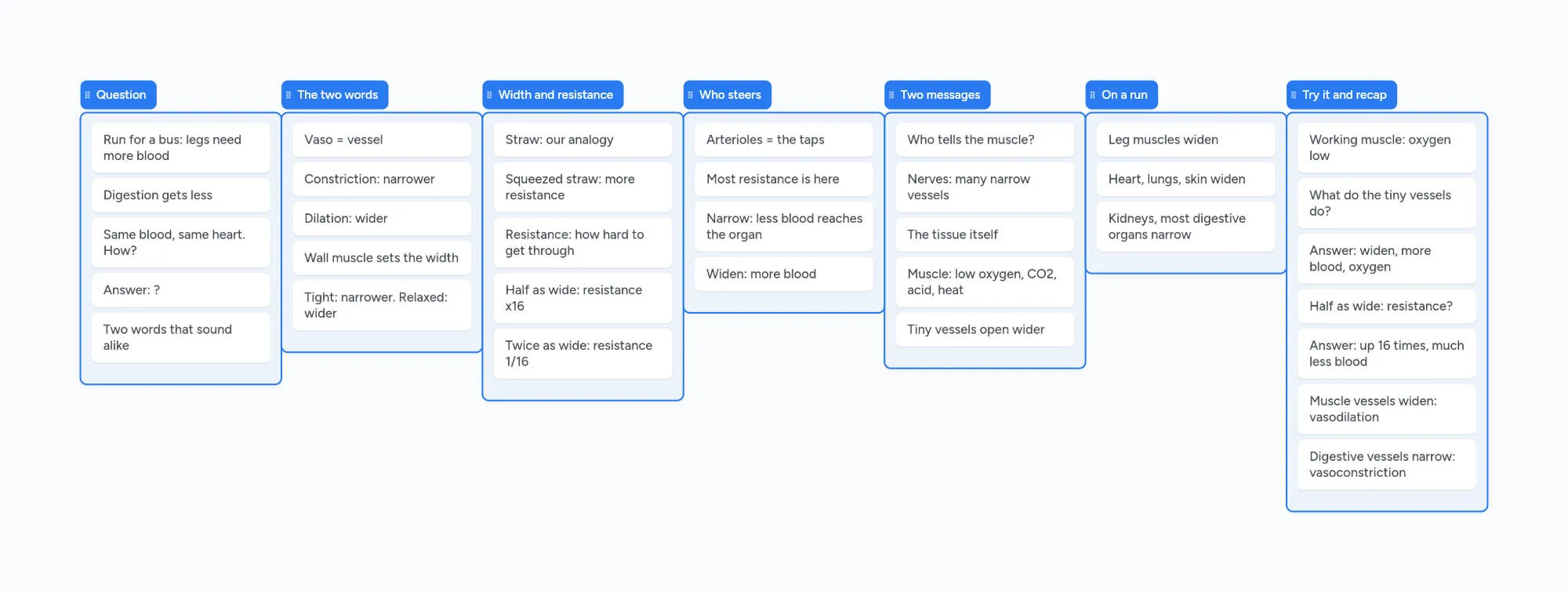
- Vasoconstriction is a blood vessel getting narrower; vasodilation is a blood vessel getting wider. "Vaso" just means vessel. The muscle in the vessel wall sets the width: tight means narrower, relaxed means wider.
- A narrower vessel has more resistance, which is how hard it is for blood to get through. The effect is large: if a vessel gets half as wide, its resistance goes up 16 times, and if it gets twice as wide it drops to one sixteenth (OpenStax, nothing else changing).
- Arterioles (small arteries) are where blood meets the most resistance, so they work like taps: narrow an arteriole and less blood reaches the organ behind it, widen it and more does.
- Two kinds of messages tell the wall muscle what to do: nerve signals (many make vessels narrower) and the tissue itself (a working muscle that is short of oxygen and makes carbon dioxide, acid and heat widens the tiny vessels that feed it).
- On a run, vessels in the leg muscles, heart, lungs and skin widen, while those leading to the kidneys and most digestive organs narrow. The blood is the same; it is steered to where it is needed.
The notes board from the lesson
This is the board built during the video. Copy it and it's yours: add your own cards, rearrange it, draw on it.
Run for a bus: same blood, how?
In the video at 0:00
Run for a bus and your leg muscles suddenly need a lot more blood, while your digestive organs, at that moment, get less. It is the same blood from the same heart, so how does your body send more to your legs and less to your digestion?
The answer is two words that sound alike: vasoconstriction and vasodilation.
Narrower vs wider vessels
In the video at 0:21
Vaso means vessel. Constriction means getting narrower, so vasoconstriction is a blood vessel getting narrower. Dilation means getting wider, so vasodilation is a blood vessel getting wider.
The wall of a vessel has smooth muscle in it. When that muscle tightens the vessel gets narrower, and when it relaxes the vessel gets wider. OpenStax calls the contraction state of this muscle the main determinant of a vessel's diameter (vascular tone).
Width and resistance
In the video at 0:42
Why does width matter so much? Think of a drinking straw (our analogy, not the book's): squeeze it and your drink barely moves. A squeezed straw has more resistance, meaning it is harder for blood to get through.
The effect is huge. OpenStax gives it as a number: if a vessel constricts to one half of its original radius, the resistance rises 16 times, and if it dilates to twice its radius, the resistance falls to one sixteenth, with everything else unchanged.
Arterioles: the taps
In the video at 1:05
The vessels that do the steering are the arterioles, small arteries. OpenStax describes the arterioles as the site of greatest resistance, so changes in their width matter most for how much blood reaches an organ.
Narrow an arteriole and less blood reaches the organ behind it; widen it and more does. The lesson on afferent vs efferent arterioles shows this at the kidney's filter.
Who steers: nerves and the tissue itself
In the video at 1:23
Two main kinds of messages tell the muscle in the wall what to do. First, nerves: many of those nerve signals make vessels narrower. OpenStax adds that a small group of nerve fibers relaxes vessels, for example in the brain and skeletal muscle.
Second, the tissue itself. A working muscle uses up oxygen and makes carbon dioxide, acid and heat. Those local signals tell the tiny vessels that feed it to open wider, so more blood arrives. (The book names the gates at the entrance to the smallest vessels, the precapillary sphincters, and chemicals such as nitric oxide, a powerful vasodilator.) The same heat and acid also change how hemoglobin lets go of oxygen: see the oxygen hemoglobin dissociation curve lesson.
Hormones can narrow vessels too; the RAAS lesson follows one chain that ends with narrower vessels.
On a run: who widens, who narrows
In the video at 1:42
During exercise the vessels in your leg muscles widen. So do those in the heart, lungs and skin. The vessels leading to your kidneys and most of your digestive organs narrow. OpenStax describes this as selective vasodilation in the skeletal muscles, heart, lungs, liver and skin, with vasoconstriction leading to the kidneys and most digestive and reproductive organs.
Same blood, steered to where it is needed.
Back to the question
In the video at 2:16
During a run, the vessels in your muscles widen, which is vasodilation, and the vessels to your digestive organs narrow, which is vasoconstriction. The heart sends out the same blood; the width of the vessels decides where it goes.
Practice question
A vessel gets twice as wide and nothing else changes. What happens to its resistance?
Show the answer
It falls to one sixteenth. Resistance depends very strongly on a vessel's radius. OpenStax gives the example that doubling the radius cuts resistance to 1/16, and halving it raises resistance 16 times, so a wider vessel lets much more blood through.
Common mix-ups
A narrower vessel lets more blood through because the blood is squeezed along.
A narrower vessel has more resistance, so (with everything else unchanged) less blood gets through. Vasodilation, a wider vessel, lets more through.
During exercise all your blood vessels widen.
Different vessels do different things at the same time: the ones in working muscles, heart, lungs and skin widen, while those to the kidneys and most digestive organs narrow.
The heart decides which organ gets the blood.
The heart sends out the same blood. The width of the arterioles, set by nerve signals and by the tissue's own chemistry, steers how much goes to each organ.
How this lesson was made
Boardling lessons are made by the Instaboard team. The narration is a synthetic (text-to-speech) voice, and the script and these notes were written with AI help, then checked against the sources listed below (last checked November 24, 2026). The notes board is built live in Instaboard during the video. Spotted a mistake? Tell us and we'll fix it.
Put this lesson in your notes
The board opens in your browser in a few seconds. Add your lecture notes, photos of your handwritten pages and your own questions next to it. Sign in for free to keep it.
Questions
What is the difference between vasoconstriction and vasodilation?
Vasoconstriction is a blood vessel getting narrower; vasodilation is a blood vessel getting wider. Narrower means more resistance and less blood through that vessel, wider means less resistance and more blood.
What does "vaso" mean?
Vaso means vessel, as in blood vessel. Constriction means narrowing and dilation means widening.
How does a blood vessel change its width?
The wall of the vessel contains smooth muscle. When the muscle tightens the vessel gets narrower; when it relaxes the vessel gets wider.
Why do muscle vessels widen during exercise?
A working muscle uses up oxygen and makes carbon dioxide, acid and heat. These local signals tell the tiny vessels that feed the muscle to open wider, so more blood and oxygen arrive.
Exam fit
- A&P
- MCAT biology
- Nursing
Sources
- OpenStax Anatomy & Physiology 2e, 20.2 Blood Flow, Blood Pressure, and Resistance: vascular tone, radius and resistance, arterioles as the site of greatest resistance (checked November 24, 2026)
- OpenStax Anatomy & Physiology 2e, 20.4 Homeostatic Regulation of the Vascular System: nerve and local control, exercise redistribution of blood flow (checked November 24, 2026)