For two writers or game designers settling the rules of one magic system
A magic system planner: rules, costs and limits as decision cards
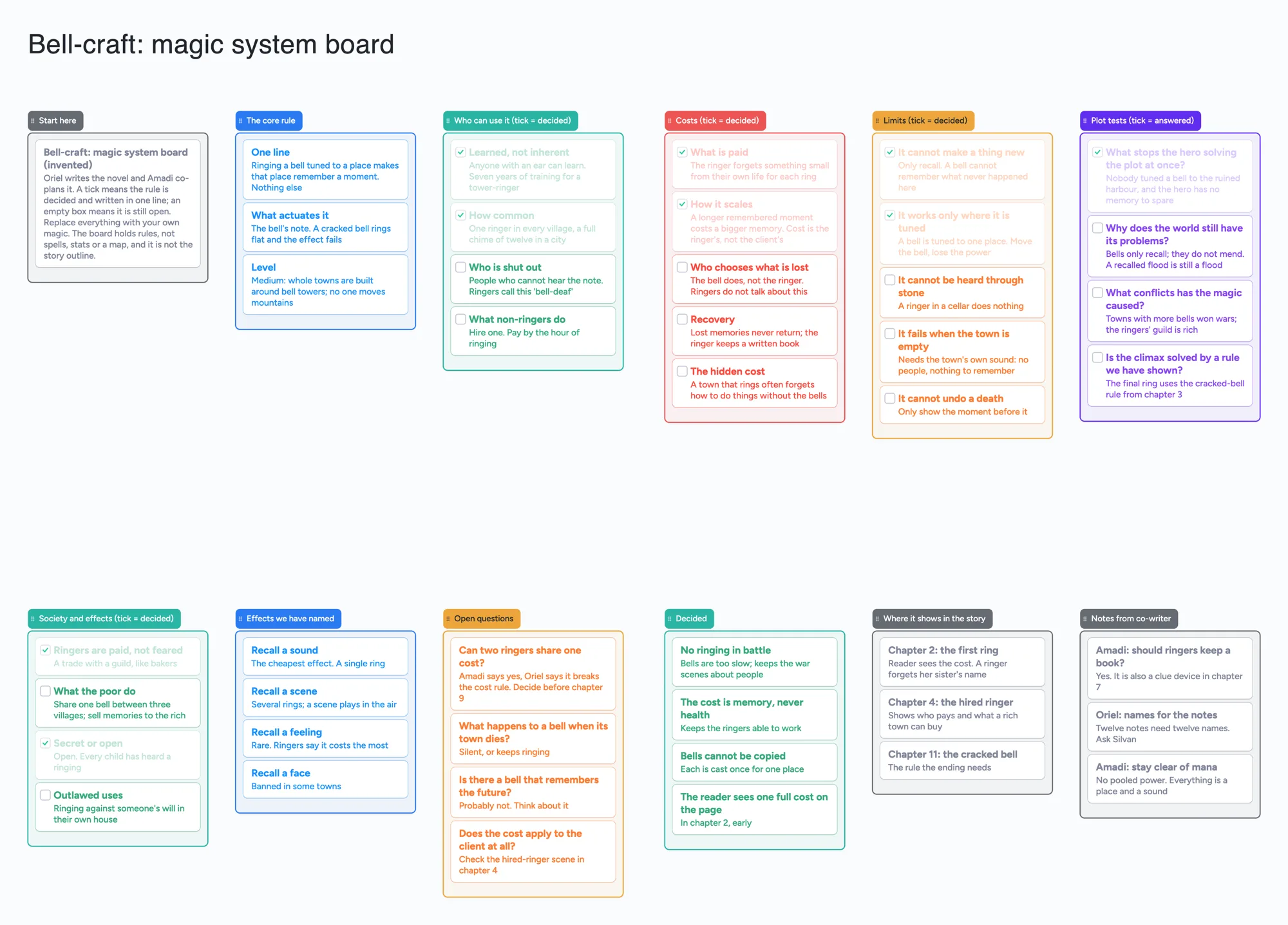
Two writers settling how one magic works can do it one decision per card: the core rule, who can use it, what it costs, what it cannot do, how society treats it, and a short list of plot tests, each with a tick box for "decided" or "answered". We make Instaboard, an online board, and this one is filled in for an invented magic, bell-craft, worked out by Oriel and her co-writer Amadi. It holds rules, not spells, stat blocks, a map or the story outline, and it does not check that your rules agree with each other. A long checklist, a wiki or a notes app does more of the detail, and we say where below. What a board adds is one screen where two people can see which rules are decided, which are open and what they disagree about.
Opens in your browser. Anyone can view; a free sign-in lets you edit.
Updated
Before you copy it: what it holds
- It holds decisions, one per card. A tick means decided (or answered, for plot tests). An empty box is an open rule. It does not tell you whether two rules clash.
- It holds rules, not the story. Chapters, scenes and the outline belong on an outline board. Spell lists, stat blocks and maps belong in your own files.
- Magic is yours to invent. The example, bell-craft, is made up for this page. No existing book, game or author is used as the system.
- The example has no arrows. A rule that depends on another is named in the card's text.
- Free plan limits: 5 boards, 150 items across your account and 3 pictures per board. A copy of this board takes 1 of your 5. Pro removes the 3-picture limit and the item limit.
- Everyone with edit access can tick or untick any card. Agree who ticks which.
When a long checklist or a notes app is the better pick
The most complete list of questions we read is a checklist posted in r/worldbuilding, "My Magic System Checklist" (by u/Flying_Tristan, October 27, 2016 (UTC); a ten-year-old thread). It asks what the magic is called, its level, whether it is learned or inherent, what actuates it, whether it is limited or universal, what the source is, whether it needs a reagent, whether it is spontaneous or prepared, how common it is and what limits it. The poster says it is "for the construction of magic systems, not worlds", and calls what actuates the effect "probably the most important part of the checklist". If you want that depth, use it, in a document or a notes app. A board is for the next step: two people deciding the answers together, one card each, and seeing at a glance which are still open. It will not prompt you with a question you forgot to ask.
Bell-craft, list by list
The magic is invented: ringing a bell tuned to a place makes that place remember a moment. Oriel writes the novel and Amadi co-plans it. The lists are our layout, not a rule.
| List | What goes in it | In bell-craft |
|---|---|---|
| Start here (grey) | What the board is and isn't, and what a tick means | One card |
| The core rule (blue) | The magic in one line, what actuates it, how big it is | 3 cards |
| Who can use it (green) | Learned or inherent, how common, who is shut out, what non-users do | 4 tick-box cards, 2 ticked |
| Costs (red) | What is paid, how it scales, who chooses, recovery, the hidden cost | 5 tick-box cards, 2 ticked |
| Limits (orange) | What it cannot do and where it fails | 5 tick-box cards, 2 ticked |
| Plot tests (purple) | Questions the story has to be able to answer | 4 tick-box cards, 1 ticked |
| Society and effects (green) | How the world treats it | 4 tick-box cards, 2 ticked |
| Effects we have named (blue) | The few things it does, cheapest first | 4 cards |
| Open questions (orange) | What isn't decided, and who is looking into it | 4 cards |
| Decided (green) | Settled, so it isn't reopened | 4 cards |
| Where it shows in the story (grey) | The chapters that show a rule on the page | 3 cards |
| Notes from co-writer (grey) | Short notes between the two writers | 3 cards |
Swipe the table sideways to see every column.
The board's own wording. Chapter numbers are typed text; the board has no timeline or outline.
Set up your own, in order
- Write the magic in one line on "The core rule", plus what actuates it and how big it is.
- Make a card for each rule on Who can use it, Costs and Limits, each with an empty tick box.
- Add the plot tests that your story has to pass.
- Decide together, tick what is settled, and put the rest on Open questions with a name.
- Share the link. New boards start view-only; to let your co-writer write, tick "Anyone who joins can edit" in Share, and each person signs in free to write.
- Agree who ticks which boxes, since anyone with edit access can tick or untick any of them.
- Keep first names only, and nothing you would not want a stranger to read.
Costs and limits first, and why they get their own lists
Two of the longest lists on the board are Costs and Limits, because two of the three threads we read, the 2025 question thread and the 2017 costs thread, centre on them. In r/worldbuilding, "What questions about a magic system should one have answered in your opinion?" (posted by u/EnvironmentalAd1006, May 23, 2025), the poster set out three laws attributed to Brandon Sanderson, among them "Limitations > Powers" (the post writes it that way), and asked for more questions. Instaboard isn't affiliated with Sanderson; the laws are quoted from the poster's post. u/PC_Soreen_Q answered "My golden rule is : EVERYTHING HAVE A COST", and u/King_In_Jello wrote "What's more important is what capabilities magic conveys and what the impact on people and world is." These are one person's views each.
- Costs list. What is paid, how the cost scales, who chooses what is lost, whether it can be recovered, and a hidden cost to the world. Bell-craft's cost is a small memory from the ringer's own life for each ring.
- Limits list. What the magic cannot do and where it fails: it recalls but cannot create, it works only where the bell is tuned, it fails in an empty town.
- Think of what the other thread asks. In "Costs and limitations for magic systems" (posted September 1, 2017), the poster says their preference is magic with costs, meaning what you pay to use it, and limitations, meaning what you can't do with it. A commenter, u/Ajreil, adds "The best part about magic's limitations and costs is finding fun ways to get around them." The Open questions list is where such workarounds go before they become rules.
Plot tests: four questions the story has to answer
The purple list copies the shape of one commenter's answer in the same 2025 thread. u/MarkerMage wrote that the first question is what stops the main character from using the magic to resolve the plot at once, and that it need not make the resolution impossible but there should be a challenge to overcome. Their second question was "Why does the world still have (insert problem/conflict here) even though they have this magic?" and the third "What problems and/or conflicts has the magic caused?". Bell-craft's cards answer each in one line, and a fourth asks whether the ending uses a rule the reader has already seen.
- Write the question as a card, with an empty tick box.
- Answer it in one line in the card text and tick the box when both writers agree.
- If an answer needs a new rule, add it to Costs, Limits or Who can use it, and untick the plot test until it is rechecked by hand.
- Tick "the climax uses a rule we have shown" only after the chapter that shows the rule is named on "Where it shows in the story".
The board can't tell you an answer is good. It shows which questions are answered and which are open.
Two writers, one rule: using Open questions and Notes
A shared board helps most when two people do not agree. In the example, Amadi thinks two ringers can share one cost and Oriel thinks that breaks the cost rule. That sits as a card on Open questions with the chapter by which it has to be decided, and the matching box in Costs stays empty until it is. Notes from co-writer is for short asides, such as keeping the magic free of pooled power.
- One card per disagreement, with both views in the text.
- Move it to Decided with the rule written once, and untick any card it changes.
- Keep a note, not a thread. One line per card is enough; nothing on the board records who changed a card or when.
Other places to settle a magic system
Read November 24, 2026. Prices and features change, so check each page. No ranking: they suit different people. Every row is what a page says; nothing is from using the tool, and Instaboard isn't affiliated with any of them.
| Tool | What its page says | Better than a board at | Where a board fits |
|---|---|---|---|
| Notion template "Magic System Builder" (Notion Marketplace) | The listing shows "$5.00" and "Last updated last year". The description says it tracks spells, costs, characters and world impacts in one dashboard. We did not open the template | A dashboard that tracks spells, characters and impacts | A visual list of decisions with no setup; no linked database |
| The r/worldbuilding checklist (u/Flying_Tristan, 2016) | A long list of questions about construction, from name and level to source, reagent and limits | Prompting you with questions you had not thought of | Recording the answers two people agreed |
| A wiki or a notes app | Not read for this page | Long entries, search, linked pages | A short, shared rules page you can see whole |
| A document | Not read for this page | Prose, examples, a printed copy | Tick boxes for decided and open |
| Your outline tool | Not read for this page | Chapters, scenes and timelines | Rules only, no chapters |
Swipe the table sideways to see every column.
From the Notion Marketplace page, the checklist thread and the other threads named in Sources, as read November 24, 2026.
Does it fit in 150 items?
Each card and each list is 1 of your 150 free items, across all your boards. The title text box counts too. Arrows, sections and pen strokes don't. Our arithmetic:
- As built: 12 lists + 44 cards + the title = 57.
- Room to grow: 150 - 57 = 93, so 93 more cards fit before the limit, one per rule.
- A second magic system on the same board would repeat the lists, so keep it on its own board: another 57, so 114; a third is 171, which passes the limit.
- Notes grow. Each note or open question is one card; delete a note once its rule is decided.
- Other boards share the 150. A co-writer who adds cards counts them toward their own 150.
Pro ($5 a month billed yearly, $59.99 a year, or $7.99 monthly) removes the item limit.
What a board can't do for a magic system
- Check that rules agree. It will not tell you a cost contradicts a limit.
- Prompt you with questions. Only the cards you write are there.
- Hold spells, stats or a map. Free boards take 3 pictures each.
- Remind or schedule. No reminders or due-date alerts, and no notice when a card is ticked.
- Record who ticked a box, or when. Anyone with edit access can untick any card.
- Keep your world private. Anyone who joins can view the board. Pro has invite-only boards.
Limits of the free plan for this board
- Items. Each card and each list is 1 of 150 free items across your account; the example is 57. Arrows, sections and pen strokes don't count.
- Boards. 5 on the free plan. "Make a copy" takes 1 of them.
- Pictures. 3 per board. The example has none.
- Writing needs a sign-in. Anyone who joins can view the board; to change it they sign in free, and the board then counts as 1 of their 5.
- Private details. A link board isn't the place for unpublished text or anything you would not want a stranger to read.
Start from the ready board
It opens in your browser in a few seconds, with nothing to install. Sign in for free when you want to save it and share it.
Questions
Does the board check that my magic rules agree with each other?
No. It holds one decision per card and a tick for decided. Whether a cost contradicts a limit is a call you and your co-writer make.
Is this the same as a story outline?
No. It holds rules only: the core rule, who can use it, costs, limits, plot tests and society. Chapters and scenes belong on an outline board, and the example only names the chapters where a rule shows.
Can I put spells, stat blocks or a map on it?
Not much. The free plan holds 3 pictures per board and the board has no tables. Keep long entries in a notes app or a document and write the name on the card.
What does a tick mean on a card?
Whatever you and your co-writer say it means. In the example a tick is decided, or answered on a plot test. The board does not check it, and anyone with edit access can untick it.
How many rules fit on the free plan?
150 items across your account, where each card and each list is one item. The example is 57, so about 93 more cards fit by our arithmetic. Your other boards share the same 150.
Is this writing or game-design advice?
No. The magic is invented to show the layout, and the questions come from threads named on this page, each one person's view.
Sources
- r/worldbuilding: "My Magic System Checklist" by u/Flying_Tristan (posted 2016-10-27 20:26 UTC; we read 89 comments with text in an archived copy, 91 in the archive; November 24, 2026)
- r/worldbuilding: "What questions about a magic system should one have answered in your opinion?" by u/EnvironmentalAd1006 (posted 2025-05-23; we read 33 comments in an archived copy, November 24, 2026)
- r/worldbuilding: "Costs and limitations for magic systems" (posted 2017-09-01; we read 22 comments with text in an archived copy, 25 in the archive; November 24, 2026)
- Notion Marketplace: Magic System Builder (listing shows "$5.00" and "Last updated last year"; read November 24, 2026)
Related
Character relationship map: a filled template two people can edit
A character relationship chart you fill in by hand: a card per character, captioned arrows, shared with a co-writer. No auto-layout or line styles.
DnD NPC tracker online: a filled board you can share with your table
A filled NPC tracker to copy: people by place, factions, a next-session list and arrows for who leans on whom. Share one link with your table. Free plan limits stated.
A visual novel planning board: scenes as cards, choices as arrows
Plan a branching story on one shared board: a card per scene, a captioned arrow per choice. Free ready board, and where Twine, Ink and Arcweave do more.