For two writers outlining one season of a series or limited series
A TV season outline board: one list per episode, four cards each
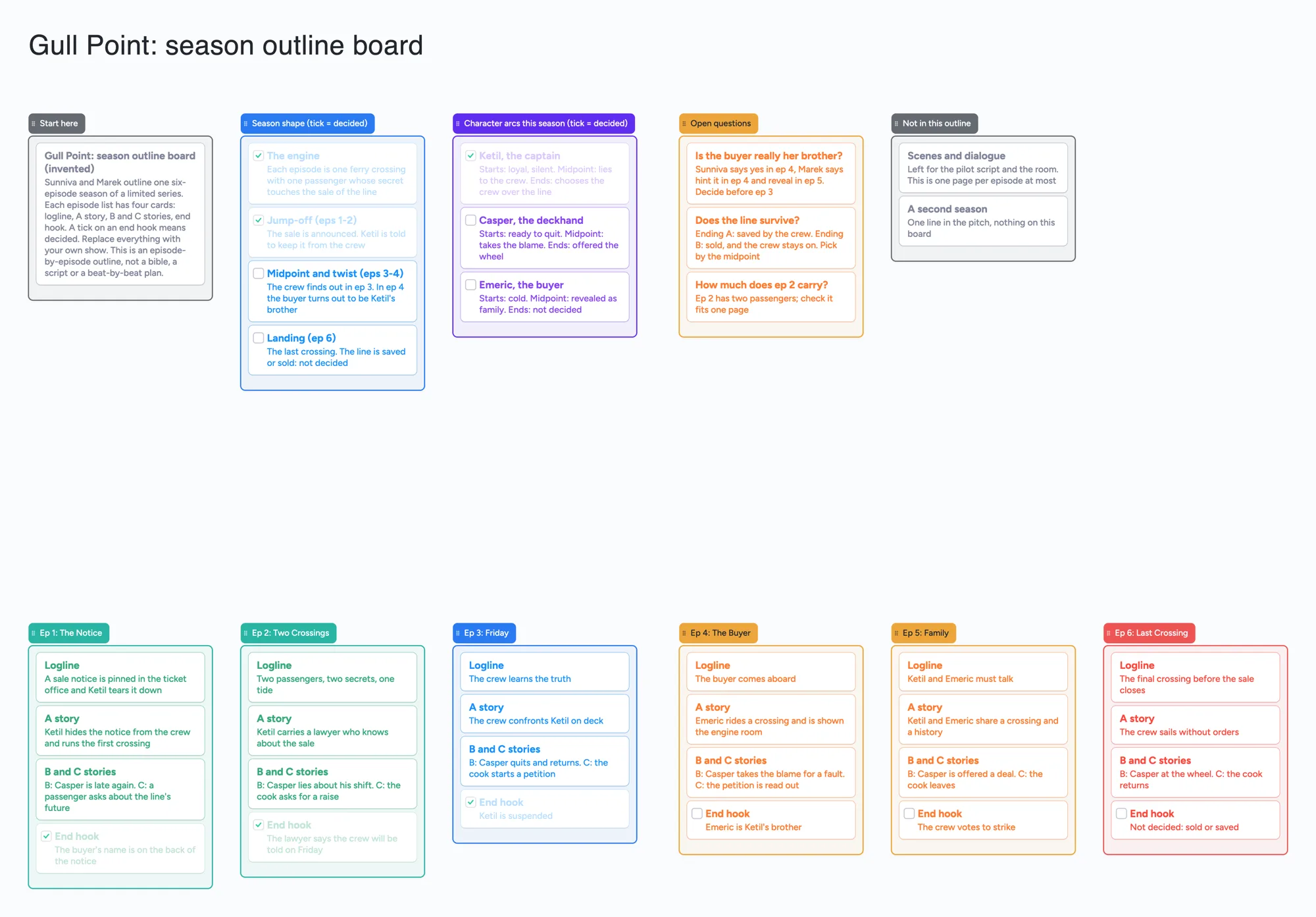
We make Instaboard, an online board. This one is for outlining one season episode by episode with a co-writer: the engine and the shape of the season, a card for each main character's season arc, and one list per episode with four cards (logline, A story, B and C stories, end hook), where a tick on the end hook means decided. It is filled in for an invented six-episode season, Gull Point, outlined by Sunniva and Marek. It is a short outline, about a card of text per story, not a series bible, a script or a beat-by-beat plan, and it does not check that your episodes add up to a season. A script editor, a bible template or screenwriting software does more of the detail, and we say where below. What a board adds is the whole season on one screen, so two people can see where the middle sags and which episode ends are still open.
Opens in your browser. Anyone can view; a free sign-in lets you edit.
Updated
What you get, and what you don't
- It holds an episode-by-episode outline, one list per episode. Each list has a logline, an A story, B and C stories and an end hook. A tick on the end hook means decided.
- It holds the season shape and each main character's arc, so two people can see the whole season at once.
- It is not a bible, a script or a beat sheet. Characters' backstories, world rules, pitch pages and scenes belong in your own documents.
- It does not check pacing. Whether episode 3 is the right midpoint is a call you and your co-writer make.
- Free plan limits: 5 boards, 150 items across your account and 3 pictures per board. A copy of this board takes 1 of your 5. Pro removes the 3-picture limit and the item limit.
- Everyone with edit access can tick or untick any card. Agree who ticks which.
How much of a season to plan before the room
Writers disagree about how much to plan alone. In r/Screenwriting, "Planning a TV Series: Entire Series or Season-by-Season" (posted November 24, 2021 (UTC) by u/LuckyTode), u/SBalbini wrote "Writers should focus on the pilot and the series engine. In a pitch, have arcs for season one thought out. Execs are asking more and more about future seasons but just give broad strokes." In another thread, "How to write a TV series outline?" (posted November 14, 2025 by u/LBarouf, who had been asked to develop 14 to 16 episodes), u/JealousAd9026 replied that "that's what the writer's room is for". Those are two people's views, not a rule.
This board is built for one season, and for the stage where you have to put a season in front of someone else, or a co-writer, before anything is written. If you are only writing a pilot, a one-page pitch may be all you need; the outline for the rest can wait.
Gull Point, list by list
The show is invented: one ferry line, six crossings, a sale announced in episode 1. Sunniva and Marek outline it together. The lists are our layout, not a rule.
| List | What goes in it | In Gull Point |
|---|---|---|
| Start here (grey) | What the board is and isn't, and what a tick means | One card |
| Season shape (blue) | The engine, the jump-off, the midpoint and twist, the landing | 4 tick-box cards, 2 ticked |
| Character arcs this season (purple) | Where each main character starts, turns and ends | 3 tick-box cards, 1 ticked |
| Open questions (orange) | What the two writers disagree about, with the episode it must be settled by | 3 cards |
| Not in this outline (grey) | What you are leaving for the script or the room | 2 cards |
| Ep 1 to Ep 6 (green, blue, orange, red) | Logline, A story, B and C stories, end hook | 4 cards each; the end hook has a tick box, 3 of 6 ticked |
Swipe the table sideways to see every column.
The board's own wording. Episode numbers are typed text; the board has no timeline or script.
How long a season the free plan holds
Each card and each list is 1 of your 150 free items, across all your boards. The title text box counts too. Arrows, sections and pen strokes don't. Our arithmetic:
- As built: 11 lists + 37 cards + the title = 49. The season-wide lists take 19 (5 lists, 13 cards, the title) and each episode takes 5 (a list and 4 cards).
- Other season lengths at four cards an episode: 10 episodes are 19 + 50 = 69; 22 episodes are 19 + 110 = 129; 26 episodes are 149.
- If each episode gets its own card per beat: with 8 cards and a list per episode (9 items), 10 episodes are 19 + 90 = 109 and 16 episodes are 19 + 144 = 163, which passes the limit.
- Two seasons on one board would double the episode lists, so keep each season on its own copy: each takes 1 of your 5 boards and its own items against the 150.
- Other boards share the 150. A co-writer who adds cards counts them toward their own 150.
Pro ($5 a month billed yearly, $59.99 a year, or $7.99 monthly) removes the item limit.
The engine and the shape of the season
The word "engine" comes from the 2021 thread above, where u/SBalbini wrote that writers should focus on "the pilot and the series engine". The shape is one script consultant's: a script-advice blog, "How to write a TV series outline" (Script Advice), uses a six-episode example: "jump-off point and major exploration of the story come in Episode 1, 2 and then Episode 3 has a building midpoint, a twist in Episode 4, more exploration in 5 and the tying up of the various threads in Episode 6". The page shows no date (read November 24, 2026), and it is the author's own consultancy and course site.
Gull Point follows that six-episode shape because our example has six episodes. It is a pattern one consultant describes, not a rule, and a 10-episode season would place the twist differently. The board's "Season shape" list is where you write yours.
- The engine card. One line for what generates episodes. In Gull Point, every episode is one crossing with one passenger whose secret touches the sale.
- Jump-off, midpoint and twist, landing. One card each, with a tick when both writers agree.
- The landing is allowed to stay open. The example leaves "sold or saved" unticked, and the end hook of episode 6 says so.
Four cards for every episode
In r/Screenwriting, "My new agent wants an episodic breakdowns of my limited series. Any superb examples?" (posted July 19, 2024 by u/DefeatingResistance), u/DonnyDandruff wrote "If your show has several protagonists, break down each episode by your A, B, C, maybe even D story." That is advice for a show with several protagonists; Gull Point has three main characters. The Script Advice blog says to break an A4 page into three and outline the jump-off, mid and end points of each episode.
The four cards on each list (a logline, the A story, the B and C stories together and an end hook) are our layout; the only support we cite for it is DonnyDandruff's A, B, C line. A card is a few lines, not a page. If you need a page per episode, write it in a document and put the logline on the card.
- Make one list per episode, titled with the number and a working title.
- Write the logline in one sentence, then the A story in two lines at most.
- Put B and C together on one card, each starting "B:" or "C:".
- Write the end hook last, and tick it when both writers agree.
A season arc for each main character
In the 2024 thread, u/le_sighs (who said they had been paid to help people develop episode breakdowns) wrote that "What you really want to focus on is the major emotional turning points for your main characters per episode." and listed the questions: where the character starts emotionally in this episode, the major thing that happens, and where they end. The Script Advice blog asks for each key character's "jump off point, their midpoint and their landing point". The board's "Character arcs this season" list gives each main character one card in that shape: starts, midpoint, ends. In Gull Point Ketil and Casper each have an ending written down and Emeric's is open.
A card is only a line per stage. Backstory, voice and relationships belong in your bible or a character document.
Two writers, one episode: using Open questions
A shared board helps most when two people do not agree. In the example, Sunniva wants the buyer revealed as Ketil's brother in episode 4 and Marek wants a hint in episode 4 and the reveal in episode 5. That sits as a card on Open questions with the episode by which it has to be decided, and the end hook in episode 4 stays unticked until it is.
- One card per disagreement, with both views in the text.
- Write the answer once on the episode card, tick it, and delete the open question.
- Keep a note, not a thread. A tick records no name and no time, and anyone with edit access can untick it.
Where other tools do this better
Read November 24, 2026. Prices and features change, so check each page. No ranking: they suit different people. Every row is what a page says; nothing is from using the tool, and Instaboard isn't affiliated with any of them.
| Tool | What its page says | Better than a board at | Where a board fits |
|---|---|---|---|
| Arc Studio (arcstudiopro.com/pricing) | Page shows no date. Free $0 with 2 scripts and no outlining tools; Essentials $69/year; Pro $99/year, listed with outlining tools, inviting collaborators, and "Season outlines" as "With 2 collaborators" | Writing the scripts themselves in screenplay format, with outlining and season outlines in the same app | A simple episode grid before anyone pays for or learns a screenwriting app |
| Notion template "THE SHOWRUNNER - TV SCRIPT WRITING" (Notion Marketplace) | Rated 4.9 from 10 ratings on the listing, which shows "Last updated 9 months ago" and no price we read. The description names character profiles, a locations database, episode guides, multi-season plans, a scripts database and pitch documents. We did not open the template | A linked workspace for characters, locations, episode guides and scripts | One screen for a single season's decisions; no databases |
| A document, spreadsheet or bible template (not read for this page) | Not read for this page | Not read for this page | A short, shared grid with a tick for decided |
| A writers' room | Not a tool; u/JealousAd9026's comment above is one person's view | Breaking story together with a team | Two people planning ahead of one |
Swipe the table sideways to see every column.
From the Arc Studio pricing page and the Notion Marketplace page, as read November 24, 2026.
What a board can't do for a season
- Check that the season works. It will not tell you the midpoint is weak or an end hook repeats.
- Hold scripts, a bible or pitch pages. Write the name on the card and keep the file elsewhere.
- Show a timeline. Episode numbers are typed; the board has no date axis.
- Remind or schedule. No reminders or due-date alerts, and no notice when a card is ticked.
- Record who ticked a box, or when. Anyone with edit access can untick any card.
- Keep your show private. Anyone who joins can view it. Pro has invite-only boards.
Set up your own, in order
- Write the engine in one line on "Season shape", then the jump-off, midpoint and twist, and landing.
- Add a card for each main character with where they start, turn and end.
- Make one list per episode with the four cards, and leave the end hook box empty.
- Fill the end hooks last, and tick each when both of you agree.
- Put disagreements on Open questions with the episode that forces a decision.
- Share the link. New boards start view-only; to let your co-writer write, tick "Anyone who joins can edit" in Share, and each person signs in free to write.
- Agree who ticks which boxes, and keep first names only and nothing you would not want a stranger to read.
What to know about the free plan before you share it
- Items. Each card and each list is 1 of 150 free items across your account; the example is 49. Arrows, sections and pen strokes don't count.
- Boards. 5 on the free plan. "Make a copy" takes 1 of them.
- Pictures. 3 per board. The example has none.
- Writing needs a sign-in. Anyone who joins can view the board; to change it they sign in free, and the board then counts as 1 of their 5.
- Private details. A link board isn't the place for an unsold pitch or anything you would not want a stranger to read.
Start from the ready board
It opens in your browser in a few seconds, with nothing to install. Sign in for free when you want to save it and share it.
Questions
Is this a series bible?
No. It holds an episode-by-episode outline for one season: season shape, character arcs, and four cards per episode. Characters' backstories, world rules and pitch pages belong in a bible or your own documents.
Does the board check that my season is paced well?
No. It holds one outline per episode and a tick for decided. Whether the midpoint lands in the right episode is a call you and your co-writer make.
Can I put scripts or scenes on it?
Not usefully. A card holds a few lines, and the free plan holds 3 pictures per board. Keep scripts and scene lists in your own files and write the title on the card.
What does a tick mean on a card?
Whatever you and your co-writer say it means. In the example a tick on an end hook, a season-shape card or a character arc means decided. The board does not check it, and anyone with edit access can untick it.
How many episodes fit on the free plan?
150 items across your account, where each card and each list is one item. At four cards an episode the example's season-wide lists plus 26 episodes come to 149, by our arithmetic. Your other boards share the same 150.
Is this screenwriting advice?
No. The show is invented to show the layout, and the ideas about outlines come from threads and a blog named on this page, each one person's view.
Sources
- r/Screenwriting: "How to write a TV series outline?" by u/LBarouf (posted 2025-11-14; we read 10 comments in an archived copy, November 24, 2026)
- r/Screenwriting: "My new agent wants an episodic breakdowns of my limited series. Any superb examples?" by u/DefeatingResistance (posted 2024-07-19; we read 8 comments in an archived copy, November 24, 2026)
- r/Screenwriting: "Planning a TV Series: Entire Series or Season-by-Season" by u/LuckyTode (posted 2021-11-24 20:28 UTC; we read 15 comments with text in an archived copy, 2 more were removed; November 24, 2026)
- Script Advice: How to write a TV series outline (the author's consultancy and course site; page shows no date; read November 24, 2026)
- Arc Studio: Pricing & Plans (page shows no date; read November 24, 2026)
- Notion Marketplace: THE SHOWRUNNER - TV SCRIPT WRITING (listing shows "Last updated 9 months ago"; read November 24, 2026)